


The Rebranding Guide: Why is there resistance from companies?

Last update: 26 February 2025 at 06:52 pm
In our first issue of the Rebranding Guide, we looked at the signs that show your company may need a rebrand.
But even when confronted with those signs… why do so many companies resist change?
In this second part of our Rebranding Guide, we dive into the barriers that hold companies back from a rebranding and what a rebranding, in practice, looks like. All backed by data from Sortlist and interviews from branding agencies Rload Studio, CRU Brand Consultancy, and Designlaboratory.
These agencies have worked on 500 branding projects since 2020, accumulating more than 20 marketing and design awards along the way.
Our data shows that 60% of businesses requesting rebranding projects specifically look for visual updates to their company, 20% specifically look for positioning, and the other 20% look for localization or updates after a merger.

As we’ve mentioned before, this means that a rebrand is a strategic decision, and the risks can feel overwhelming. But Rome was not built in a day, and the payoff of a successful rebrand far outweighs the risks.
Let’s explore why some companies avoid it and how others execute it successfully.
4 roadblocks keeping companies from rebranding
Attached to the past
Your brand is like your baby. It’s normal to be protective of it.
Emotional attachment extends to both customers and employees: it accounts for about 43% of business value, surpassing the value derived from promoting product features, which stands at 20%.
And internally, an employee’s engagement to the brand could affect the outcome of a rebrand.
The idea of altering or abandoning a familiar logo, name, or overall brand image can feel like erasing a part of the company’s legacy.
However, overcoming the emotional attachment to your preexisting brand can pay off handsomely when done at the right moment. In fact, rebranding is part of keeping your customers aware of your brand, and it can’t happen if you’re stuck with the image that you know no longer works.
Fear of losing loyal customers
An important concern always raised when discussing rebranding is that it might confuse or alienate existing customers.
There’s a case study that supports this: Aunt Jemima’s rebranding to Pearl Milling Company. Simply changing the brand name resulted in less purchases, less brand affinity, and less brand trust overall.

This is why in any rebranding process, the first steps are the most significant. Brand strategy, deep audience research and comprehensive company positioning – done by professionals, reduces the risk. So finding the right rebranding partner is essential – it’s a high stakes game – but with a big payoff.
And the same can be said for the rollout of the rebrand. By engaging customers throughout the whole process and clearly communicating the reasons for change can help maintain loyalty, and even strengthen their relationship with the brand.
Just look at what the Co-operative Group did after partnering with London-based agency Robot Food: their rebranding strategy began with simply addressing the way people referred naturally to the Co-op Group in the UK (just “Co-op”).

That simple insight helped inform the rest of the rebranding strategy, from tone of voice, to psychology of color, to packaging.
The result? A 15% increase in active membership and 21% increase in sales.
“We can’t afford it”
The costs associated with rebranding are tricky to pinpoint, since they entail different parts of a brand such as market research, design, campaigns, and digital assets. Without proper guidance, it can be costly.
On Sortlist, companies allocate an average amount of €15,000 for rebranding projects.
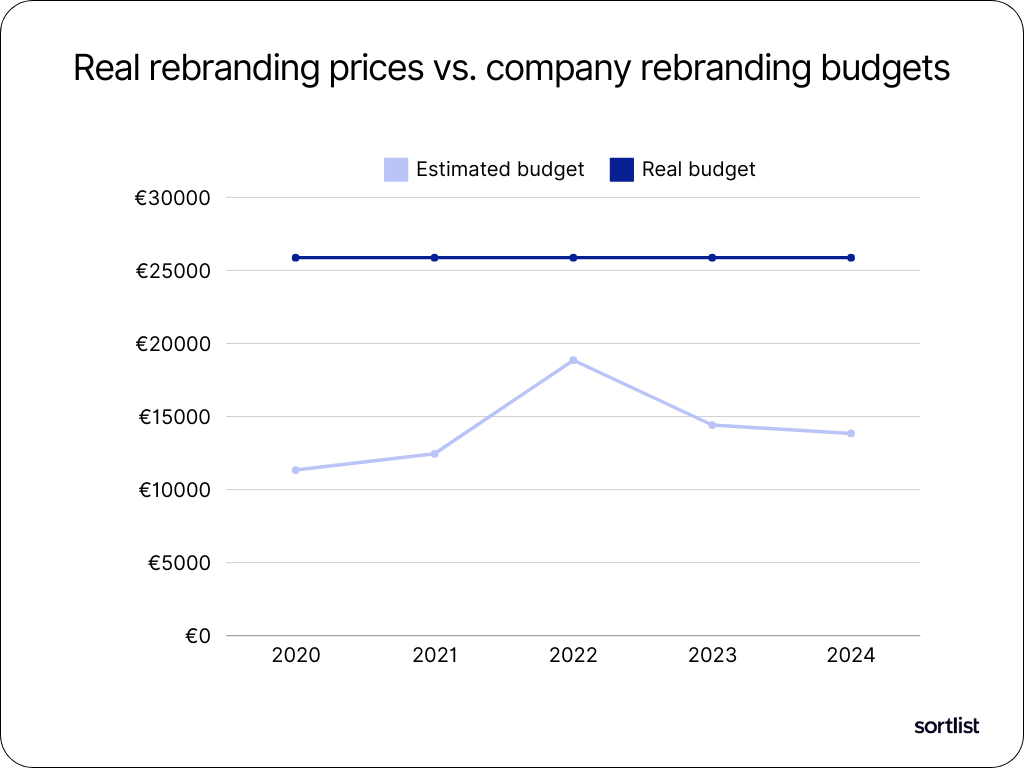
However, Boris Thuery from Designlaboratory, a UK-based creative and narrative-driven agency, argues that clients should understand what happens when budget is prioritized.

“It’s the same as facing the Venn diagram that puts together costs, quality, and time. You have to pick two. At designlaboratory, we make sure we never compromise on quality, so what are you left with?“
–Boris Thuery, cofounder and CEO of Designlaboratory
The main reason for such a tremendous gap in company budgets and actual agency prices lies in the misunderstanding of what a rebrand entails.
A branding or rebranding package, including a basic website, typically needs two to three months of work, since it is not merely about the visuals.
There is research work at an initial stage with founders and CEOs to get to know exactly who is the ideal customer for a brand and what is its personality. The results of that research inform the rest of the positioning in the market and the brand’s visuals.
Because of that, a rebrand project could range anywhere between €25,000 and €40,000.
And for a startup seeking a brand and web presence to kickstart their business, the budget should be around €30,000 to €40,000, with a timeline of two to three months. This includes full brand guidelines, beyond the logo, fonts, and color palettes.
“Some clients don’t know what a brand is; they normally think it’s only a trend or a pretty logo. Because of that, they want something quick and fast. So you need to make them understand why it costs that much, which is also why we are very transparent with the scope of work that explains all the steps.“
–Boris Thuery, cofounder and CEO of Designlaboratory
The only correct way to see a rebrand is as an investment, since it strengthens your market position, improves your customer’s perception, and done well, even increases conversion rates across all channels.
Rebranding also aligns your messaging with the right audience, making marketing campaigns more effective and reducing wasted ad spend.
When brands fail to invest properly, they often face higher long-term costs: inefficient marketing, missed opportunities, and lower customer retention.
No time, no team
Many companies lack the internal resources or expertise to manage a rebranding initiative effectively.
The process requires a complete multidisciplinary approach – that involves market analysis, creative design, strategy, and project management. Without dedicated teams or experience in these areas, the task will easily overwhelm any company.
Bea Carballo, co-founder of Spanish creative agency Rload Studio, summarizes the skillset in the following way:

“Skills that are needed: knowing how to listen and how to be sensitive to the client; staying up to date with trends and having aesthetic and business culture references; remaining observant, analytical, and creative in equal parts.“
–Bea Carballo, cofounder of Rload Studio
You might even need to consider testing your new messaging and design; it’s crucial to ensure they resonate with the target market. This can involve focus groups, surveys, and other research methods, which require additional resources and expertise.
The reality is that having the in-house skill sets a rebrand requires makes little sense. Even the biggest companies turn to professional branding agencies to get their rebrand done. PayPal worked with Pentagram and Dunkin’ Donuts worked with JKR to do theirs.


But branding comes in all shapes and sizes, and for a smaller company with fewer creative structures in place, working with a skilled agency can be even more beneficial.
Anatomy of a successful rebrand
By now you’ve seen that rebranding isn’t just about slapping on a new logo. It’s a strategic process that involves several key stages. This is how the pros get a complete rebranding done:
Know where you stand: discovery and audit
This is about assessing your current brand health, gathering customer insights, and identifying gaps.
Expert agencies like CRU Brand Consultancy and Rload start by conducting interviews and workshops with company leaders and founders. In the case of Designlaboratory, the results of that initial audit becomes the brief for the rebrand project.

“When you have a story to translate your theoretical strategy into, then it changes so much in the company already. Even though we still need to design everything and get a visual perspective and develop all the assets, you feel like you behave differently.“
–Lasse Giese, cofounder of CRU Brand Consultancy
Skills needed:
- Market research
- Analytical skills
- Communication (report writing, presentation skills)
Define your edge: strategy and positioning
In this second step, you define your mission, values, and unique differentiators.
This is done through an analysis of the market research, the competition, consumer behavior, and other market trends relevant to the brand’s industry.
In this phase, companies should understand that, in order for a new brand to happen, there’s a whole process of awareness and projection into the future that must be assimilated.

Research indicates that high-growth companies are proactive when it comes to positioning; approximately 81% of such companies have rebranded at least once.
Skills needed:
- Data-driven decision making
- Strategic thinking
- Communication and messaging
Bring it to life: creative concepts
This is the part people commonly associate with a rebrand: developing visuals and messaging that reflect your strategy. But the key ingredient is learning how to connect the strategy from steps 1 and 2 to the creative process.
“Here we move on to the strategic design phase, which helps us define the new brand personality, style, and visual identity.“
–Bea Carballo, cofounder of Rload Studio
The rebranding of Mailchimp in 2018 serves as a notable example. Collaborating with the agency Collins, Mailchimp aimed to retain its core essence while refreshing its visual identity, demonstrating the impact of cohesive creative concepts when rebranding.

Skills needed:
- Creative thinking
- Visual storytelling
- Design skills
- Prototyping and testing
Make it real: implementation and launch
In this step all brand touchpoints are updated, from your website to social media profiles.
This is particularly important, since overlooking smaller visual elements can lead to inconsistencies and confusion.
A typical rebrand involves updating an average of 215 assets, from initial discussions to rollout.

Using a Digital Asset Management (DAM) platform can help manage and distribute new brand assets efficiently, ensuring that all team members have access to the latest resources.
Skills needed:
- Project management
- Stakeholder communication
- Problem-solving skills
- Leadership skills
- Quality assurance
Did it work? Post-launch analysis
Here’s when you bring it all full circle: measure the impact of the rebrand on key metrics like brand awareness, customer engagement, and sales.
Brand awareness can be measured through surveys that gauge brand recall and brand recognition, while customer perception and sentiment can be measured through social media sentiment analysis and Net Promoter Score (NPS) evaluations to determine loyalty and likelihood to recommend the brand.
For example, the lawn services company Green Thumb Landscaping saw a 50% increase in social media interactions and an improvement in review ratings from 3.5 to 4.2 within three months after a rebranding campaign.
“Branding is not a cosmetic change; it has a proper business impact. There’s no good wind if you don’t know where you’re sailing.“
–Lasse Giese, cofounder of CRU Brand Consultancy
Skills needed:
- Data analysis
- Monitoring
- Feedback gathering
- Optimization
- Reporting and communication
Successful companies follow this roadmap, ensuring each step is data-driven and customer-focused.
You’ve decided to rebrand… so how do you do it?
Rebranding is not just about knowing when and why to refresh your brand… it’s about executing it the right way.
Even the biggest companies turn to branding agencies to navigate the risks and reap all the rewards from a successful rebranding campaign.
In the third and final part of this series, we’ll dive into the practical side of rebranding: how do you actually go through the process? Who do you consult? And perhaps most importantly, how much does it cost?
Stay tuned as we break down the prices and other considerations to make your rebrand a sure win.


