

How AI Co-Branding Campaigns Are Changing the Game in 2025

Last update: 19 May 2026 at 03:54 pm
 5.00/5
Co-branding had become one of the most effective ways for companies to expand their reach and connect with new audiences by 2025. However, the way these partnerships are formed and carried out has changed. Today, businesses use artificial intelligence for this purpose. The question now becomes: How will you use AI to expand your reach?
Rather than relying solely on brainstorming sessions and manual coordination, marketers use AI to find better brand matches, generate content, and fine-tune campaigns in real time. The result? Faster launches, more personalized experiences, and stronger results for both partners. These benefits will greatly impact any business in any industry. Including yours!
The AI revolution is real. Since 2023, the majority of CMOs have expressed optimism about this technology. The percentage of those holding this sentiment increased by nine points, jumping from 74% in 2023 to 83% in 2025. The message for marketing professionals is clear: Knowing how to use AI for co-branding isn’t just a nice skill to have, it’s becoming essential.
Key Takeaways
- AI is revolutionizing co-branding in 2025. Brands are using AI to speed up partner discovery, personalize content, and optimize campaigns in real time, making co-branding faster, smarter, and more cost-effective.
- Traditional co-branding is being outpaced. Compared to manual methods, AI-driven co-branding offers better audience alignment, unified messaging, scalable creativity, and measurable ROI.
- Success requires the right balance. While AI provides automation and efficiency, human oversight is essential to maintaining brand integrity, emotional resonance, and ethical alignment.
- You can start small and scale strategically. Businesses don’t need to overhaul their marketing strategy. They can start by identifying partners, aligning on goals, testing a few AI tools, and iterating based on results.
What Is AI Co-Branding
Before discussing how AI co-branding campaigns are changing the game in 2025, it’s important to define what AI co-branding is.
AI co-branding uses artificial intelligence to facilitate and optimize partnership-based marketing campaigns between two or more brands. Unlike traditional co-branding, which relies on manual coordination and static content, AI co-branding uses machine learning, predictive analytics, natural language generation, and automation tools to enable faster, smarter, and more scalable brand partnerships.
We highly recommend reading our blog post, “3 Types of Co-Branding and How to Find Your Perfect Match,” to learn more about co-branding.
How AI Is Reshaping Co-Branding Partnerships
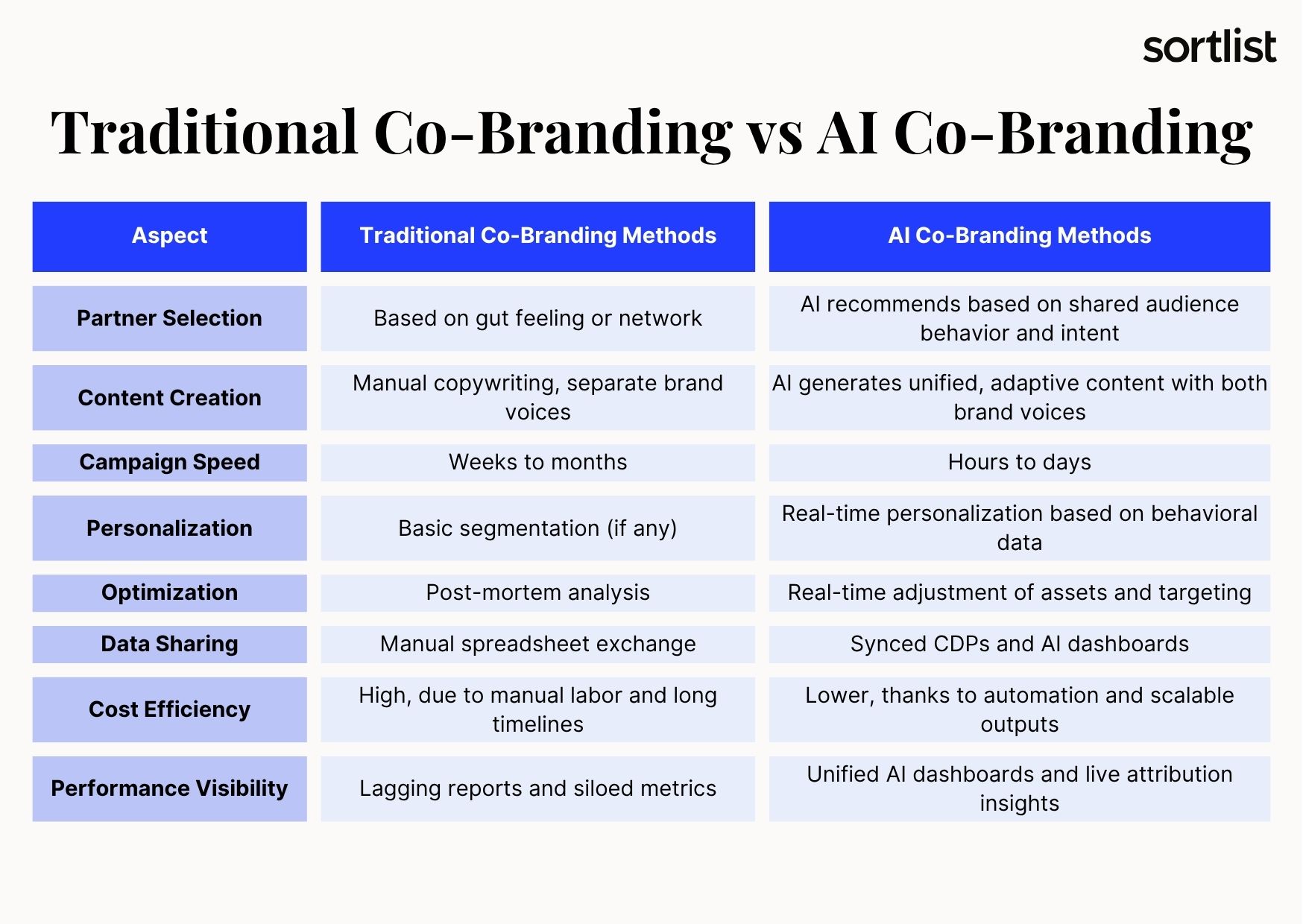
As you can see, AI is revolutionizing co-branding in 2025 by injecting speed, intelligence, and precision into what was once a slow and fragmented process. This allows room for:
- Faster brand alignment: AI tools can scan and compare two brands’ audience segments, values, tone, and historical campaign data to assess compatibility in minutes, which would otherwise take teams days or weeks.
- Intelligent audience targeting: AI identifies overlapping audience behaviors, buying triggers, and engagement patterns to build campaigns that resonate with shared customers. This ensures relevance and minimizes wasted ad spending and a successful co branding partnership.
- Personalized content generation: Tools like ChatGPT and Jasper co-write blogs, social media posts, and email sequences tailored to both brands’ audiences and new customer segments. AI adapts language, tone, and calls to action (CTAs) based on user behavior in real time.
- Predictive campaign modeling: Before launching a campaign, AI can simulate outcomes based on historical performance to suggest the ideal channels, timing, and messaging combinations for maximum ROI.
- Real-time optimization across channels: AI monitors engagement, sentiment, and conversion in real time. It automatically adjusts ad copy, creative, and budget allocation across platforms like Meta, TikTok, and Google Ads.
- Scalable creative collaboration: Generative AI enables brands to co-create thousands of ad variations, visuals, and landing pages while maintaining brand integrity without the need for large creative teams.
- Transparent performance insights: Shared AI dashboards provide both partner brands with real-time access to unified KPIs, heat maps, sentiment analysis, and conversion attribution, enabling faster and smarter decision-making.
- Reduced costs and higher ROI: AI streamlines manual tasks, shortens production cycles, and decreases the need for large creative or analytics teams. This strategic partnership helps brands save on labor and production costs while improving performance and achieving a stronger return on marketing investment.
Common Mistakes & Limitations When Finding a Co Branding Partner with AI
Although AI has massive potential, it’s not without its challenges. Here’s what you, as a marketing professional, must watch out for:
- Over-automation without human oversight: Although AI can generate content quickly, without brand oversight, you risk tone-deaf messaging and off-brand visuals, which can damage your brand reputation and customer loyalty.
- Mismatched brand values: AI may give you suggestions of partnerships based on audience overlap, but it doesn’t always understand the emotional or cultural fit between your brand and others.
- Creative homogenization: Using the same AI tools as many other brands, without custom prompts or training, may result in co-branded content that feels generic or algorithmically generated.
- Poor data governance: Without clear agreements on how customer data is shared and used, AI personalization can pose compliance or privacy risks for your company, particularly under GDPR or CCPA.
- One-way integration: More often than not, one brand in the partnership invests in AI tools while the other lags behind. This creates an imbalanced effort that affects alignment, campaign performance, and co branding initiatives.
- Ethical concerns: Deepfake voice, AI-generated influencers, and auto-personalized offers can mislead consumers if they are not transparently disclosed, which can lead to a loss of trust.
- Prompt engineering bottlenecks: Effective AI output depends heavily on quality prompts. Without skilled prompt engineers or trained marketers, campaigns risk producing irrelevant or low-impact content.
The best advice we at Sortlist can offer is to always pair AI with clear human review loops, shared brand standards, and aligned KPIs between partners. Now, let’s review if your brand is ready for co-branding and the steps you need to take to begin using AI co-branding.
Is Your Brand Ready for AI Co-Branding?
You might be wondering if now is the right time to explore AI-powered co-branding. This quick self-assessment will help you understand your level of readiness and pinpoint areas for improvement before launching your next campaign.
First answer the following questions:
1. Do you collect and use customer behavior data?
- Yes, and we use it regularly to shape campaigns
- Yes, but we rarely act on it
- No, not yet
2. How familiar is your team with AI tools for marketing or content creation?
- Very familiar: we use tools like ChatGPT, Jasper, or Canva AI often
- Somewhat familiar: we’ve experimented with a few
- Not familiar: we haven’t used AI yet
3. What’s your main goal for a co-branding campaign?
- Drive sales and conversions
- Build brand awareness and engagement
- Enter a new target market or audience segment
4. Do you already have a co-branding partner in mind?
- Yes, we’re already in talks or planning
- We’re open to exploring potential partners
- No, we need help finding the right fit
5. Do you have clear creative guidelines and shared values that could align with another brand?
- Yes, we have brand docs and visual assets ready
- Somewhat, it’s not fully documented yet
- No, we’d need to build this from scratch
Once you have finished answering all the questions, you need to check your answers:
- If you mostly answered “Yes,” your brand is AI co-branding ready. You have the necessary tools, data, and strategy to launch a campaign with confidence. Now is the perfect time to experiment, scale up, and connect with expert agencies on Sortlist.
- Did you mostly get “Somewhat”? You’re on the right track. With a few adjustments, such as running a pilot campaign or collaborating with a specialized partner, you can close the gaps and move toward full AI integration.
- If you mostly selected “No”, you’re still building the foundation. Focus on improving your data strategy, clarifying your brand identity, and experimenting with entry-level AI tools to prepare for more advanced co-branding efforts. No matter your score, Sortlist can help you take the next step.
How Businesses Can Get Started with AI Co-Branding
You don’t need a complete overhaul of your marketing strategy to get started with AI co-branding. You just need to take a smarter, more focused approach to partnerships. To help you with this, we’ve built a step-by-step guide that explores AI-powered collaborations.
Our blog post “Co-Branding: 7 Successful Examples to Inspire Your Next Co-Branding Campaign”can serve as a source of inspiration for your next co-branding opportunity.
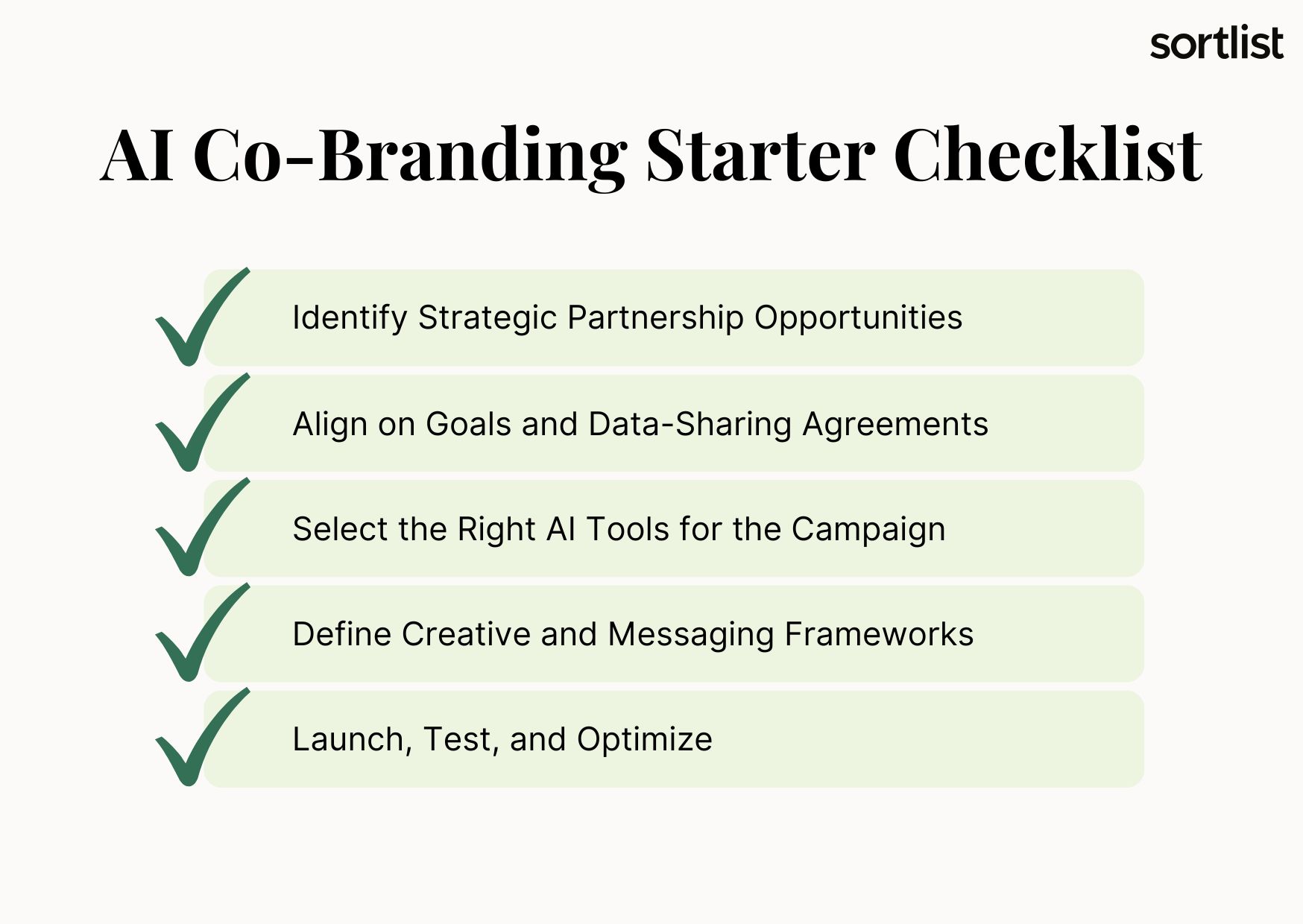
Step 1: Identify Strategic Partnership Opportunities
Begin by assessing your existing audience data. Use AI-powered customer intelligence tools, such as Amplitude or Segment, to identify behavioral similarities with potential partners. Look for reputable brands with:
- Shared audience demographics or psychographics
- Complementary products or services
- Common values or brand positioning
Step 2: Align on Goals and Data-Sharing Agreements
Before adding AI tools to your processes, you should ensure that your potential partners are aligned on key co-branding strategy objectives. This growing adoption has also increased interest in genai development services for building more adaptive and content-driven customer experiences. To do so, sit down and ask yourselves:
- What does success look like? For example, you can aim to generate $250,000 in co-branded product revenue and achieve a minimum 5% conversion rate from campaign landing pages within 60 days.
- Which metrics will be tracked, and how will data be shared? Following the previous example, you should aim to track revenue from co-branded products, landing page conversion rate, cost per acquisition (CPA), and number of units sold.
- Who owns which content and customer insights?
Ensure compliance with GDPR, CCPA, and other data protection regulations when syncing customer data or analytics platforms.
Step 3: Select the Right AI Tools for the Job
Based on your co marketing campaign needs, you need to start choosing the tools that will support your efforts. For example:
- Audience targeting: GWI Spark and Brandwatch are among the best options in the market
- Content generation:ChatGPT, Jasper AI, Sora, and BrandWell are great tools used by multiple brands and highly recommend for you
- Design automation: You can start with Canva Magic Studio, Midjourney, or Adobe Firefly
- Campaign optimization: We highly recommend using Smartly.io or Mutiny
Our best advice at this stage is to start small. Test one or two tools with limited scope before scaling across multiple channels.
Step 4: Define Creative and Messaging Frameworks
Although AI can generate content, it still requires creative direction from the brands involved. Collaborate with your partner to create:
- Shared brand voice guidelines
- Shared values
- AI prompt templates
- Visual identity and brand image rules (logos, color palettes, and fonts).
Going through this process will ensure consistency and prevent mismatched messaging for your target audience in your marketing campaigns.
Step 5: Launch, Test, and Iterate
Once your co branding campaign is live, you want/need to use AI analytics platforms to monitor the performance and be able to make real-time adjustments. You want to focus on:
- A/B testing creative and messaging
- Optimizing placement and timing
- Track shared KPIs on unified dashboards.
At this point, you are basically using AI-driven insights to run post-campaign reviews and determine what worked and what didn’t for the two companies involved in this strategic alliance.
Conclusion
AI co-branding represents a shift in how smart companies approach partnership marketing. By combining human creativity with machine precision, your business can move faster, reach more relevant audiences, and create value on a large scale.
The necessary tools and techniques are already within reach. Start small, test strategically, and grow from there. With the right partner and AI tools, your next co-branding campaign can be the most targeted, efficient, and impactful yet.
The only question left is: Will you lead this transformation, or will you watch others pass you by?


