
What Agencies Need to Know About Product Ops in 2025

Last update: 27 March 2026 at 05:09 pm
 5.00/5
In an ever-evolving marketing and tech landscape, one concept is gaining rapid traction among high-performing teams: Product Ops. In 2025, Product Ops is no longer a niche function confined to SaaS companies; it has become a critical component for marketing agencies looking to deliver consistent, scalable, and data-driven services.
Through this blog post, we will answer questions such as:
- What exactly does Product Ops entail in 2025?
- How can agencies integrate Product Ops into their workflows?
- What are the most common pitfalls of Product Ops, and how can they be avoided?
By the end, you will have a clear understanding of how Product Ops can drive efficiency, alignment and measurable value for your agency, plus the tools and techniques you need to get started.
Key Takeaways
- Product Ops is essential for agencies: It has evolved into a strategic function critical for scaling operations and delivering consistent, high-quality work.
- Cross-functional alignment drives success: Product Ops connects product teams, sales ops, marketing ops, and client services to streamline workflows and accelerate decision-making.
- Tools and metrics matter: Using the right platforms (Asana, Airtable, Notion, etc.) and tracking key KPIs ensures effective Product Operations and measurable results.
- Structured feedback and automation boost performance: Incorporating customer feedback loops and leveraging AI-driven automation increases efficiency and campaign success.
What Is Product Ops and Why Should Agencies Care?
Product Operations (Product Ops) is the function that sits at the intersection of product management, data, and operations. Its purpose is to streamline communication, optimize tools and processes, and enhance product delivery by providing structure, insights, and operational support. It’s an invaluable role not only for product managers and product teams, but also for cross-functional collaborators like strategists and client service leads
For marketing agencies, understanding and implementing Product Ops can be beneficial in many ways.
- Improve client delivery consistency
- Enhance collaboration across cross-functional teams
- Accelerate decision-making through data insights
- Increase agility and reduce inefficiencies.
Investing in Product Ops will future-proof your agency’s operations, enable efficient scaling, and improve outcomes for clients and internal teams.
When you’re operationalizing product work across teams, it helps to align processes with a growth motion where the product drives adoption—this guide to product-led growth SaaS breaks down how to do it.
The Evolution and Fundamentals of Product Operations in 2025
Due to the growing demand for operational scalability, data-led decision-making, and cross-functional agility, Product Ops has evolved beyond basic process optimization. As client expectations rise and digital workflows become more complex, your agency needs a more integrated, proactive approach to managing products and services.
In 2025, Product Ops has matured into a strategic function that:
- Centralizes product and project data for better decision-making
- Aligns stakeholders across departments
- Implements and maintains a robust tooling ecosystem
- Supports launch readiness and post-launch optimization
- Standardizes communication and processes within teams, the entire organization, and with clients
- Leverages AI and predictive analytics for automation and planning.
Agencies that embrace these fundamentals and advancements will see measurable improvements in speed, scalability, and client satisfaction. This evolution reflects increased collaboration among product operations managers, product managers, and execution teams to bring agency projects to life.
Key Factors Driving the Rise of Product Ops in Agencies
As agency workflows become more interconnected and data-heavy, you probably already know that operational bottlenecks are becoming harder to ignore. Product ops is the solution that unifies teams, tools, and insights, helping agencies stay ahead in an increasingly competitive landscape.
- Evolving Client Expectations: Clients now expect agile, technology-enabled teams that deliver predictable, high-quality results. They no longer tolerate delays, inconsistencies, or vague reporting. Product Ops helps agencies meet these demands with streamlined processes and clear accountability.
- Increased Cross-Functional Complexity: Agencies now manage creative, development, strategy, media, and analytics teams across various platforms. This complexity requires structured coordination and shared visibility, both of which are core strengths of Product Operations and core concerns for modern product teams.
- Tool Overload: The average agency tech stack includes dozens of communication, planning, asset management, and analytics tools. Without operational alignment, these tools become silos. Product Ops provides a central nervous system that connects these tools and ensures they are used properly.
- Data Abundance Without Strategy: Agencies possess a wealth of performance, behavioral, and operational data. However, without the right systems and roles in place, this data goes unused. Product Operations enables teams to transform raw data into actionable insights that drive customer success through smarter decisions and stronger results.
Strategies and Practical Applications of Product Ops
Implementing Product Ops requires more than good intentions; it demands intentional structure, cultural alignment, and practical implementation tailored to how agencies work. No matter what type of work your agency does, whether it’s running digital campaigns, managing client retainers, or building branded experiences, these strategies will help you embed Product Ops into your daily operations.
- Designate a product operations lead. Assign or hire a product manager, or a specialist to oversee Product Ops. This person should have strong operational instincts and a deep understanding of agency workflows. Ideally, they will have experience in project management, client services, or product strategy. For some agencies, this may be an experienced product operations manager who can bridge operational gaps across teams, and collaborate with sales ops and marketing ops.
- Centralize tools and templates. Consolidate project briefs, campaign assets, and timelines into a single, standardized system. This improves transparency and enables faster, more consistent onboarding of new team members or clients.
- Establish feedback loops. Establish structured and frequent communication cycles between teams and clients. Post-mortems, retrospectives, and live campaign reviews ensure continuous improvement and keep delivery aligned with expectations. It’s important that you collect and incorporate customer feedback at every stage.
- Make data-driven decisions. Give product ops teams access to real-time campaign and operational data through dashboards or automated reports. This allows for smarter, faster decision-making and justifies strategy shifts with evidence.
- Operationalize campaign launches. Develop templated workflows for campaign setup, quality assurance (QA), creative approvals, and reporting. A well-documented process reduces errors, accelerates time-to-market, and ensures consistency for clients.
If you need expert help with product operations implementation, we highly recommend browsing top product management partners on Sortlist to find the right fit for your needs.
Recommended Tools to Support Product Ops
While all of this sounds interesting, you can’t implement it without the right tools. These platforms will help you unify workflows, eliminate redundancy, and provide visibility across teams and clients.
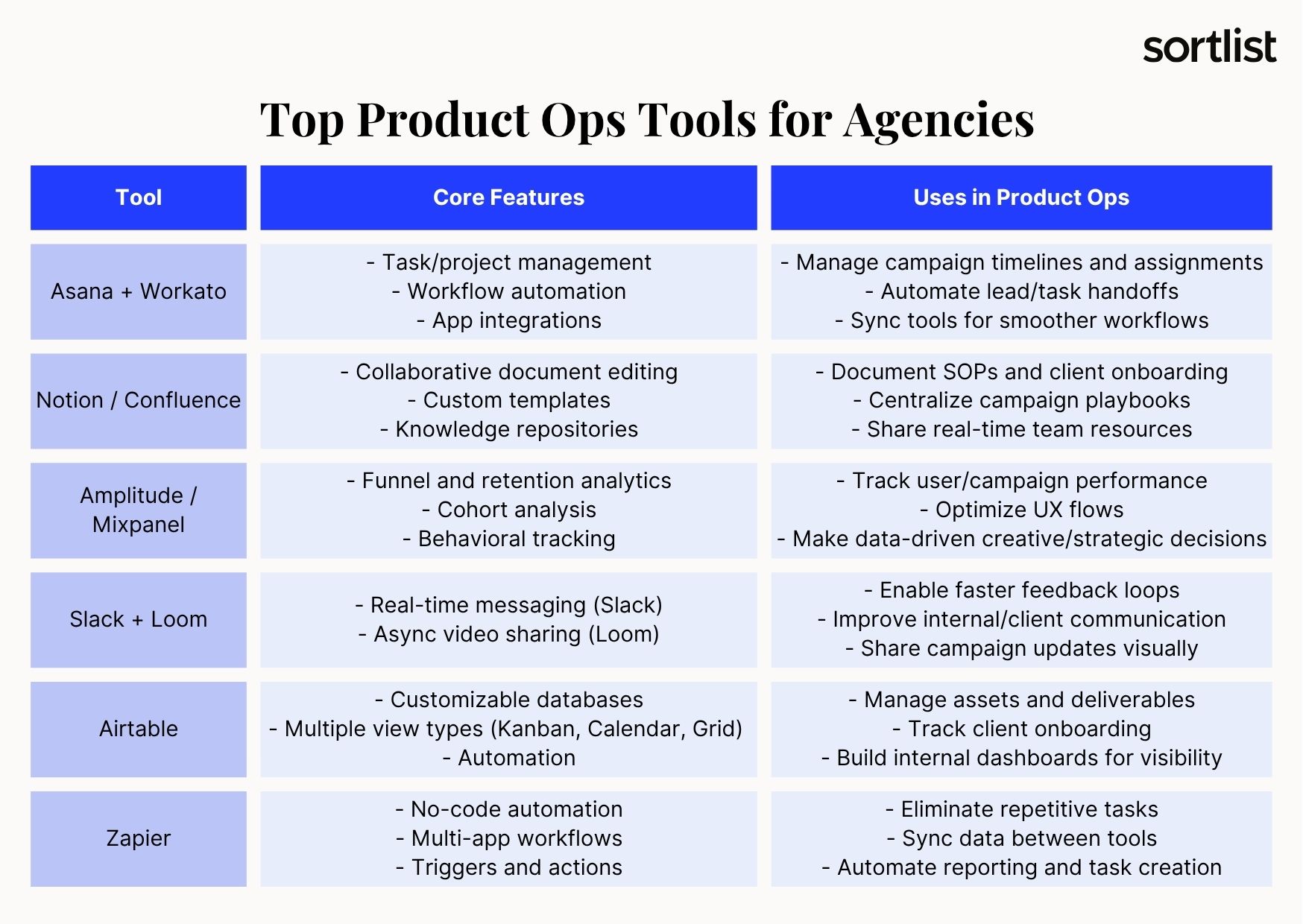
Up next, we share with you the top tools that we at Sortlist believe will help agencies like yours implement product operations in the best way possible.
Asana and Workato
A powerful combination for project management and automation. Asana helps you organize campaigns, manage deadlines, and assign tasks with clear visibility. When paired with Workato, Asana connects different apps and automates workflows, such as moving a lead from a CRM to a task board or syncing approvals across tools. This helps you, your project managers and your product team be on the same page, save time and reduce errors.
Notion or Confluence
These platforms are ideal for internal knowledge management and enable agencies to document standard operating procedures (SOPs), client onboarding guides, creative briefs, and campaign playbooks in one place. Their collaborative editing and customizable templates ensure that everyone, from creatives to strategists, has access to up-to-date information.
Amplitude or Mixpanel
These analytics tools offer deep insights into user and campaign behavior. At you agency you can use them to track funnels, analyze retention, and perform cohort analyses on digital experiences. This data is critical for optimizing conversion paths, improving user experience (UX), and informing iterative creative and strategic decisions.
Slack + Loom
Effective communication is essential for agency operations, and these tools facilitate faster and clearer communication. Slack supports real-time messaging and integrates with other tools. Loom enables your team to record quick video walkthroughs and updates, which is great for asynchronous feedback or sharing campaign reviews with clients.
Airtable
This flexible, visual database platform is perfect so you can keep track of projects, assets, deliverables, and team availability. With grid, Kanban, and calendar views, your agency can create customized dashboards for content calendars, client onboarding pipelines, and more.
Zapier
A no-code automation tool that links your entire tech stack. Whether you need to sync form responses to project boards, update status reports, or push files to cloud storage, Zapier eliminates the need for manual, repetitive work, freeing teams to focus on high-impact tasks and business processes.
Metrics to Measure Product Ops Success
Measuring the success of Product Ops is about more than just tracking output. It’s also about evaluating the quality, efficiency, and consistency of your agency’s operations over time. Agencies can prove their value internally, optimize workflows, and strengthen client relationships by focusing on the right KPIs.
If you know where to look, you can find these metrics within your existing tools. For example, project management platforms like Asana and Airtable can help you track campaign cycle time and launch readiness using timelines and task completion rates. While you can measure tool adoption and team satisfaction using internal surveys, feedback loops, and usage data from platforms like Notion, Slack, and Loom. Another option is to integrate analytics dashboards using tools like Mixpanel, Amplitude, or Google Data Studio to monitor feedback loop completion and campaign performance.
With that in mind, to evaluate the impact of your Product Ops initiatives, you want to track these key metrics:
- Campaign cycle time: How quickly can your team launch?
- Tool adoption rate: Are teams consistently using standardized platforms?
- Team satisfaction score: How satisfied are internal teams with workflows?
- Feedback loop completion: Are client and internal reviews happening regularly?
- Launch readiness score: How prepared is the team before campaigns go live?
Conclusion
By 2025, agencies seeking to scale efficiently, meet rising client expectations, and deliver high-quality work will need to prioritize product operations. It’s not just a trend; it’s a strategic necessity that fosters collaboration among product teams, sales operations, marketing operations, and the entire product operations department.
Are you ready to implement Product Ops in your agency? Start small, designate an internal champion, and scale your systems for long-term success. If you need help, you can always reach out to any of the best product management teams in our directory. They are there to help you through every step of the process.