

Copy Strategy: What It Is, How to Create One, and Real Examples (2025 Guide)

Last update: 18 June 2026 at 03:11 pm
A copy strategy is a one to two-page document that summarizes a digitalmarketing strategy. It helps guide the communication actions that a company wants to carry out.
In other words, a copy strategy is a specification that allows an agency to know exactly what it must do to meet the expectations of an advertiser.
In this article, we give you a definition of copy strategy, as well as explain why and how to create one.
Copy strategy: Definition
A copy strategy is a roadmap between an advertiser and a communications agency. In concrete terms, an advertiser will ask an agency to create an advertising or marketing campaign. Within this framework, the two parties will agree on specifications.
This document defines the broad outlines of the project that the advertiser entrusts to the agency. It is, therefore, a reference document established at any communication campaign’s launch.
In short: the copy strategy defines all the elements that a communication action must respect. It accompanies, completes and integrates with your brief by providing your agency with framing elements.
Copy strategy: Why is it essential to create one?
In communication and marketing, a good strategy is essential. A copy strategy meets this requirement.
It is a document that aims to define the strategy that the advertiser’s message should follow. Structuring your promotional campaign, defining the guidelines, and developing the techniques that will be used to create a powerful message is what makes up a good communication strategy.
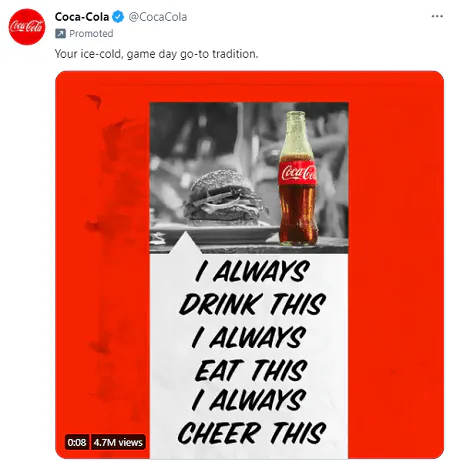
Coca-Cola ad copy image from ShareThis
If communication is not your business, you should call upon the services of a specialized agency. It can advise you and implement an effective copy strategy. This will give the agency all the elements necessary to create your campaign.
Indeed, the copy strategy gives precise advice on the message to broadcast and the brand tone to favor the alignment between your campaign, objectives, target, and brand positioning.
Therefore, defining a copy strategy summarizes the communication action you want to take and clearly indicates your communication agency.
How is a copy strategy used in modern digital marketing?
A copy strategy has always guided how a brand communicates, but the way it is used today looks very different from its origins. While the traditional approach was designed for TV, print, and radio campaigns with a single unchanging message, digital marketing requires constant adaptation, micro-segmentation, and multiple versions of the same message. This evolution has transformed the copy strategy into a more flexible and data-informed framework.
Difference between traditional advertising vs. digital copy strategy
In traditional advertising, a copy strategy served as the foundation for a large campaign running over weeks or months. It typically revolved around five classic components: the promise, the proof, the benefit, the tone, and the residual message. This was sufficient when communication channels were limited and feedback was slow.
Digital marketing changed this dynamic completely. Brands now operate across dozens of platforms, each with unique formats and audiences. A modern copy strategy must therefore:
adapt the message to multiple awareness levels
guide different formats (short-form, video, long-form, UGC, etc.)
support rapid testing and iteration
align with performance data and user behavior
In short, the strategy must be dynamic, not static.
How it applies to modern digital channels
Landing pages
A copy strategy shapes the narrative structure of a landing page. It determines the headline (core promise), the value proposition, the hierarchy of benefits, and the tone used throughout the page. Because landing pages must convert quickly, the strategy ensures every element reinforces the same message.
Social ads (Meta, TikTok, LinkedIn)
Digital ads require multiple message variations for different segments and creative formats. A copy strategy provides:
platform-specific hooks
consistent messaging across ad sets
tone adaptations (professional on LinkedIn, playful on TikTok)
clear CTAs aligned with campaign goals
It becomes the reference point for A/B tests, retargeting messages, and creative iterations.
Email marketing
Email sequences depend on narrative consistency. The copy strategy helps define:
the messaging arc of a welcome series
the tone and emotional angle of nurturing emails
the core value proposition behind promotions
the level of formality and urgency in the CTA
This ensures all emails feel cohesive, even when sent over weeks. This consistency only pays off once there’s a list to send to — outbound teams typically pair their copy strategy with an email finder to source verified addresses for the welcome and nurture sequences in the first place.
Product pages
On product or service pages, the strategy guides how features are translated into benefits, how objections are addressed, and which proof points strengthen credibility. It helps shape a clear, persuasive buying journey that’s consistent across product lines.
Why the framework evolved beyond the classic Promise / Proof / Benefit Model
The traditional model is still relevant, but today’s digital landscape requires deeper strategic layers. Online users interact with brands through fragmented touchpoints, shifting intents, and fast-scrolling environments. They expect messages that are both clear and tailored.
Because of this, modern copy strategy incorporates components that were not historically needed, such as:
customer insights extracted from reviews, interviews, and analytics
awareness-stage mapping (unaware → most aware)
refined value propositions adapted to micro-segments
message pillars to maintain consistency across formats
CTA strategies based on funnel stage
continuous testing and optimization
These additions make the strategy more robust and better suited to performance-driven digital communication.
Ultimately, the copy strategy evolved to keep pace with the realities of online marketing: faster cycles, more channels, more data, and audiences who demand clarity and relevance at every touchpoint.
How do you identify the target audience for a copy strategy?
You must conduct market research and analyze consumer insights to identify the target audience. This involves understanding the demographics (such as age, gender, and location) and psychographics (such as interests, values, and lifestyle) of the target audience.
Gathering data on consumer behavior, preferences, and needs helps in developing content that speaks directly to their interests and motivations.
How to create a copy strategy: 5 key elements
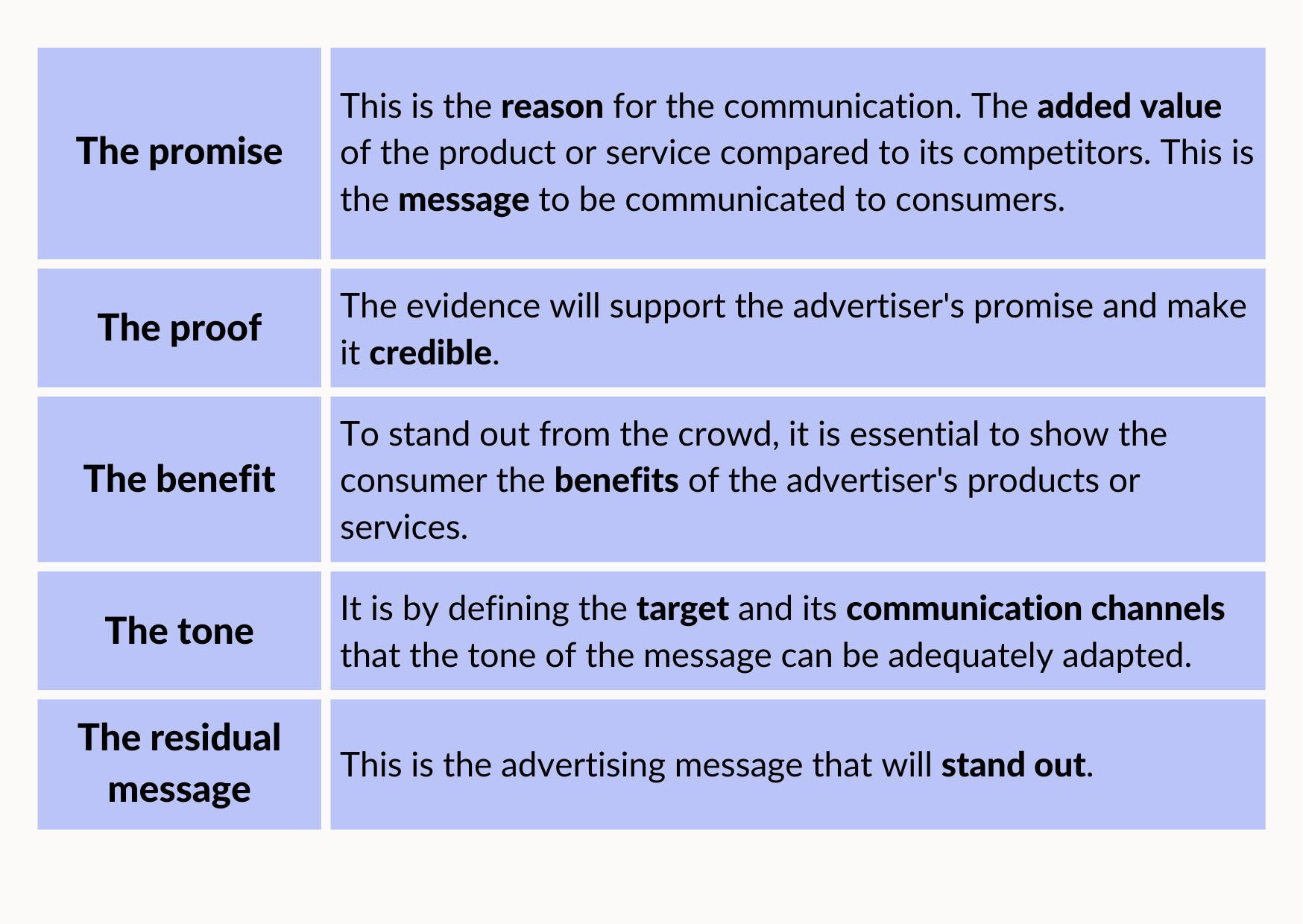
The copy strategy comprises five elements that guide the communication and frame the message to be conveyed to an audience.
The promise
The “promise” of the copy strategy is the reason for the existence of the communication action.
Before you begin writing or before the campaign is launched, any communication action must answer some fundamental questions:
- What is its objective?
- What does it promise to its target audience? Who is its target?
- How can the product or service subject to the communication message meet the customers’ expectations?
- How do these products and services stand out from the competition?
It would be best if you answered these questions at the beginning of your copy strategy. Take the time to summarize the promise your product makes to your customers. This allows the agency to understand how to turn your communication campaign.
The proof
The proof will support the advertiser’s promise and make it credible.
- How can the advertiser prove it is the best choice for the consumer?
- Is it through years of experience?
- From customer satisfaction?
Copy strategy teams must determine the key points and arguments to make the message credible and trustworthy to its potential customers.
The benefit
For your brand to stand out amongst your competitors, it is essential to show the consumer the value and benefits that he will be able to get from the advertiser’s products or services.

Slack Facebook ad copy via PowerAdspy
How will they benefit from the promise made? At this stage, the agency in charge of the campaign will have to write copy that is both accurate and provides a positive description of the advertiser’s products and services.
The tone
To determine the tone, it is essential to have defined the audience and the communication channels. We do not address all customers or audiences in the same way!
- Is the message aimed at a young or older audience?
- Will the message be broadcast on traditional media or social networks?
- Is it to make the audience laugh or to raise awareness?
By defining the advertiser’s target audience and answering these questions, the tone of the message can be adapted appropriately.
The residual message
This is the advertising message that the target audience will remember.
It is a fundamental element. It will determine the audience’s opinion of the business’s messages and the company.
This last step of the copy strategy must be used to determine the few fundamental and central elements of the message that will be the most impactful and mark the audience.
Once these five aspects have been reviewed and clearly defined, the team developing the communication action will have a detailed roadmap. It will allow them to get the advertiser’s message across in the best possible way.
Add these modern elements to your copy strategy (based on current best practices)
While traditional copy strategy frameworks remain useful, modern digital marketing requires a more detailed, insight-driven approach. Audiences today expect tailored messages, personalized experiences, and communication that adapts to their level of awareness. To meet these expectations, brands must integrate several additional components into their copy strategy—elements designed to improve clarity, relevance, and performance across all channels.
Customer insights & research
Effective messaging doesn’t come from guesswork. It comes from understanding how customers think, what they struggle with, and what they’re trying to achieve. This is why customer research has become a core part of modern copy strategy. Instead of relying solely on internal perspectives, brands collect real-world insights that reveal what truly motivates people.
Some of the most valuable research methods include:
Review mining, which uncovers recurring pains, expectations, and language patterns directly from customers
Surveys and interviews, which reveal deeper motivations, hesitations, and emotional triggers
Competitor analysis, which helps identify gaps in messaging and opportunities to differentiate
These insights influence the entire strategy—from value propositions to tone of voice—ensuring the message resonates authentically with the audience.
Awareness stage of the audience
One of the most important elements in modern messaging is understanding where your audience stands in their decision journey. Eugene Schwartz’s classic five awareness stages remain highly relevant:
Unaware
Problem Aware
Solution Aware
Product Aware
Most Aware
The same message will not work for all stages. Someone who doesn’t yet know they have a problem needs educational, empathetic messaging, while someone comparing providers needs proof, benefits, and differentiation. Incorporating awareness stages into your copy strategy ensures the message aligns with audience readiness, improving both engagement and conversion.
Value proposition
Your value proposition is the foundation of your messaging, but in digital marketing, it must be sharper and more specific than ever. It should capture not just what you offer, but why your solution is the best choice in a crowded market.
There are several types of value propositions:
Brand value proposition, which communicates what the brand stands for
Product value proposition, which focuses on specific features and benefits
Experience value proposition, which highlights ease, convenience, support, or overall user experience
A common misunderstanding is confusing value propositions with benefits. Benefits describe what the customer gets, while the value proposition explains why this solution is the right one, and why it matters. Clarity here makes the rest of your copy significantly stronger.
Message pillars
Message pillars help maintain consistency across channels, formats, and audiences. Instead of writing new copy from scratch each time, brands rely on three key components that anchor their communication:
The core message, which represents the main idea or promise the brand wants to be known for
Supporting arguments, which reinforce the promise through proof, features, differentiation, or emotional angles
These pillars make your messaging system scalable. They help social media teams, email marketers, performance advertisers, and copywriters stay aligned even when producing different formats.
Call-to-Action (CTA) guidelines
Every message must lead somewhere, which is why CTA strategy is an essential addition to a modern copy strategy. A CTA should not be an afterthought; it needs to reflect the user’s intent and awareness level.
At a basic level, your CTA guidelines define:
What you want users to do (sign up, download, buy, book a call, explore more, etc.)
How the CTA varies by channel, since a TikTok CTA differs from a landing page CTA, and a LinkedIn CTA may need a more professional tone than a Meta ad
Modern copy strategy incorporates CTA variations for each platform and audience segment. This ensures that the user journey feels seamless, and that every touchpoint moves the user closer to the action you want them to take.
Copy strategy: Example
Let’s take the five elements explained above and apply them to Sortlist. This will show you how to use them and should help you see how to create a copy strategy.
A Little Context
To give you some context, Sortlist is a startup founded in 2014 by Thibaut Vanderhofstadt, Nicolas Finet, Michael Valette, and Charles De Groote. Sortlist reinvents agency selection consulting by offering marketing decision-makers a personalized, data-driven service.

Via the platform, they can identify the most relevant agencies to meet their marketing, creative, and digital needs. To help them in their choice, decision-makers can count on the support of a team of experts at their disposal.
Sortlist attracts start-ups and SMEs that need support on both operational and strategic issues.
Since 2017, Sortlist’s expertise has also been called upon by major accounts, such as Renault, Pernod Ricard, Société Générale, and Ina, to help them remain innovative and competitive.
Example of a copy strategy
Promise
Sortlist helps companies find the best digital and marketing service providers to accompany them in their digital strategy. In return, Sortlist helps agencies grow and find clients seeking expertise.
Proof
Every week, more than 700 companies visit Sortlist to find an agency. These companies can be startups, SMEs, or large accounts such as Renault, Pernod Ricard, Société Générale, and Ina.
Benefits
Sortlist allows advertisers to save time and easily find the best service providers on the market.
Tone
Sortlist adopts a serious, neutral tone suitable for startups, large accounts, and SMEs.
Residual message
Sortlist is the platform when your company needs digital support and needs to find an agency quickly without questioning the quality of the work that will be provided.
This is a quick example, but it should give you a better idea of how to create a copy strategy for your future communication campaign.
Other aspects of a copy strategy
We have just seen that a copy strategy is based on five key elements. But in reality, the more the copy strategy is refined, the more parameters will be involved in developing a good marketing strategy.
For example, are there any particular obstacles or difficulties to the communication action?
These may be budgetary or legal restrictions. Sometimes, current events can affect the reception of certain advertisements.
By questioning the strategy and refining the objectives of the message, the copy strategy developed will enable the teams to implement the most appropriate communication action possible.
Unique selling proposition (USP)
The unique selling proposition (USP) is a distinctive feature or benefit that sets a product or brand apart from competitors. It is a critical element of a copy strategy as it helps communicate the brand’s unique value and why consumers should choose it over alternatives.
The copy should highlight the USP prominently to create a memorable and persuasive message.
Emotion
Emotion plays a crucial role in copy strategy as it helps connect with the audience on a deeper level. Copywriters can create a more memorable and impactful message by leveraging emotions such as joy, fear, or empathy.
Storytelling techniques, evocative language, and relatable scenarios can evoke emotional responses and engage the audience more profoundly.
Consistency
Consistency is vital in copy strategy as it helps build brand recognition and strengthens its messaging. Consistent use of brand voice, tone, and messaging across different marketing channels and touchpoints ensures a cohesive and recognizable brand identity.
It helps establish trust and familiarity with the audience, making the brand more memorable and distinct.
Copy strategy vs. Creative brief vs. Brand strategy
In marketing teams, it’s common for several strategic documents to coexist, and just as common for people to use the terms interchangeably. A copy strategy, a creative brief, and a brand strategy all guide communication—but each plays a different role, serves a different purpose, and appears at a different stage of the marketing process. Understanding these differences helps teams avoid confusion, streamline collaboration, and ensure that messaging remains consistent across channels.
Quick comparison table
| Document | Purpose | Focus | When It’s Used |
|---|---|---|---|
| Copy Strategy | Defines the message, tone, value proposition, and proof points | What the brand says and how it says it | Before creating copy for campaigns, ads, landing pages, or product pages |
| Creative Brief | Aligns the marketing and creative teams on goals, deliverables, and direction | The big idea, campaign objectives, constraints, audience, and assets | At the start of a campaign or creative project involving designers, videographers, or creatives |
| Brand Strategy | Defines the foundation of the brand: positioning, mission, vision, values, and personality | Who the brand is, how it behaves, and how it is perceived | During brand development, rebranding, positioning work, or long-term strategy |
When to use each
You use a brand strategy when defining or revisiting your overall identity. It comes into play during brand audits, rebranding efforts, market repositioning, or when building a new brand from scratch. It establishes your brand’s “why” and “who.”
A creative brief is used at the start of a specific campaign or creative project. It guides designers, copywriters, and creative teams by outlining what needs to be produced, who it’s for, and why the campaign exists. It is the project roadmap.
A copy strategy, on the other hand, is used whenever you need clarity on what the message should be. It sits between brand strategy and creative execution. You use it when writing landing pages, ad copy, emails, social ads, or defining the messaging for a launch or campaign. It provides the precise language, tone, and arguments that embody the larger brand strategy within day-to-day communication.
Why brands confuse them
Many companies confuse these documents because they all touch on elements of communication. They reference the audience, highlight objectives, and provide direction—but at different altitudes.
Brands often mix them up for three reasons:
- The documents overlap in terminology (audience, tone, value, message).
- Smaller teams sometimes combine all three into a single document for convenience.
- Many marketers don’t clearly differentiate between strategic identity and tactical execution.
What helps is remembering this hierarchy:
Brand Strategy = who we are.
Copy Strategy = what we say and how we say it.
Creative Brief = how we’ll bring it to life for this project.
When teams recognize these distinctions, decision-making becomes smoother, messaging stays coherent, and campaigns perform better across every touchpoint.
Developing your copy strategy
Have you finished writing your copy strategy? Congratulations! Now, the teams of the agency of your choice will have to develop the communication action.
However, you may find that some things won’t work or won’t have the desired effect.
With social networks, communication is no longer a one-way street. The advantage for brands is that they can quickly know what consumers think about them and their products.
It is essential to analyze the reception of your communication activities by the public. Sometimes, advertising messages do not get through, and changes are necessary.
In this case, you should not hesitate to revise your copy strategy, change the tone, or insist on other aspects. Consider making use of content collaboration tools to ensure that your messaging remains always in line with your overall marketing strategy and business goals. Another possibility is to look at the brand’s competitors, see what works well with them, and then adapt your copy strategy.
Also, remember that copy strategy evolves with the brand. It can be a question of a change in positioning, an evolution of the target, or a change of product/service, for example.
So, you must remain flexible and never lose sight of your objective and audience. We tell you more about understanding your audience in this article dedicated to community building.
How do you measure the effectiveness of a copy strategy?
The effectiveness of a copy strategy can be measured through metrics such as engagement rates, click-through rates, conversion rates, and sales revenue. It can also be evaluated through customer feedback and market research.
- Engagement rates – include open rates, click-through rates, and time spent on a website or social media post. High engagement rates indicate that the copy resonates with the target audience.
- Conversion rates – This metric measures the percentage of visitors who take a desired action, such as purchasing or signing up for a newsletter. High conversion rates indicate that the copy persuades the audience to act.
- Sales revenue – This metric measures the revenue generated from the copy strategy. If sales increase after implementing a new copy strategy, it can be attributed to its effectiveness.
- Customer feedback – Gathering customer feedback through surveys or reviews can help determine if the copy strategy resonates with the target audience and if any improvements can be made.
- A/B testing – Comparing the performance of different versions of a copy strategy can help identify which elements are most effective in resonating with the target audience.
Overall, the effectiveness of a copy strategy should be measured against the goals and objectives set for the marketing campaign.
Common mistakes to avoid when creating a copy strategy
Even with a solid framework, many brands fall into predictable traps that weaken their messaging. A copy strategy is designed to bring clarity and alignment, but when key elements are overlooked, the final message becomes diluted and far less effective. Understanding the most common mistakes will help you avoid them and create a strategy that supports consistent, persuasive communication.
1. Overgeneralizing the audience
One of the biggest pitfalls is trying to speak to everyone. When brands write for a broad or undefined audience, the result is usually vague messaging that doesn’t resonate with anyone. A strong copy strategy requires specificity: a clearly defined target, a clear problem, and a clear desired outcome.
2. Skipping customer research
Many teams build their messaging based on assumptions instead of real customer insights. Without research—whether through review mining, interviews, surveys, or user feedback—the strategy risks missing the problems, motivations, and language patterns that actually drive decisions. Customer research is the foundation of any modern copy strategy.
3. Confusing features with benefits
Features describe what a product does; benefits explain why it matters. When brands focus too heavily on features, they fail to communicate value from the customer’s perspective. Benefits highlight outcomes, transformations, and the emotional or practical gains users care about. A balanced copy strategy helps teams stay anchored in benefits while supporting them with relevant features.
4. Using inconsistent voice and tone
Inconsistent tone across websites, ads, emails, and social content creates friction in the user experience. A brand that sounds professional on LinkedIn but overly casual on its landing pages risks confusing or alienating its audience. A copy strategy should outline clear voice and tone guidelines to ensure coherence across all touchpoints.
5. Not updating the strategy over time
Markets evolve, customers change, and new competitors appear. When brands treat their copy strategy as a one-time exercise, the message quickly becomes outdated. Revisiting and refining the strategy regularly ensures that your communication stays relevant, aligned with product changes, and responsive to real audience expectations.
In conclusion
All companies build marketing and advertising strategies. They aim to create an identity and stand out from the competition.
In general, companies start with a visual identity. Very often, their advertising messages use the same codes. Some brands also create a sound identity, using a slogan or sounds their customers will remember.
This is, for example, the case of Ixina, whose radio jingle everyone knows.
But beyond the image that brands give themselves, they also define the tone they will adopt:
- Are they addressing young people, older adults, or families?
- Do they adopt a more serious or sarcastic tone?
This tone depends on the image they want to project:
- Do they want to appear modern and innovative or rather conservative and traditional?
- What values do they appeal to?
All these aspects are fundamental when it comes to building a communication campaign. Of course, building a campaign doesn’t happen overnight. It requires real reflection work to be led by your communication agency.
This is where the copy strategy comes in. Thanks to this document, you can carry out your communication campaign.
If you need an agency, go to our site. We can offer a selection to measure according to your needs and project.


