

Content Creation in 2025: How Businesses Are Using LLMs to Stay Ahead

Last update: 22 April 2026 at 02:18 pm
Content creation has always been the backbone of marketing, but the way businesses produce content is changing dramatically in 2025. Large language models (LLMs) are the driving force behind this change. These advanced AI tools can generate blogs, emails, social posts, and product descriptions in minutes.
This shift is happening quickly. Industry forecasts show that over 89% of businesses are using AI-driven tools like LLMs for content marketing in 2025. For marketing managers and small business owners, the connection is clear: LLMs enable the production of more content faster and with consistent quality, helping teams save time and maintain a competitive edge.
This article explains how LLMs work, why they matter, the most effective ways to use them, and how to avoid common mistakes.
Let’s dive in!
What Are LLMs (In Plain English)
A large language model (LLM) is an advanced AI system trained on vast amounts of text. It can understand context, answer questions, and generate text similar to human writing. In practice, this means you can use an LLM to quickly draft marketing emails, blog posts, and social media captions.
Some of the most widely used large language models (LLMs) in marketing today include OpenAI’s GPT models, such as ChatGPT, and Anthropic’s Claude. These tools are popular because they are versatile and user-friendly, and they can adapt to different tones and industries.
The key benefit for your marketing team is that LLMs can be trained to reflect your brand’s tone and target audience, so they don’t just generate generic words.
Why LLMs Matter for Small Businesses & Marketing Teams
For small businesses and marketing teams with limited time and resources, LLMs offer clear benefits:
- Efficiency: LLMs can generate high-quality drafts in minutes, reducing the time your team spends writing from scratch. This allows you to produce more content without increasing your staff.
- Consistency: AI ensures a consistent tone, style, and message across all channels, helping your brand maintain a professional and recognizable voice in blogs, social media posts, emails, and product descriptions.
- Cost savings: Automating repetitive writing tasks lowers your need for outsourcing content creation or hiring additional staff, making content production more affordable.
- Scalability: LLMs allows you to quickly increase your content output. For instance, a single blog post can be adapted into social media posts, email campaigns, and landing page copy. This enables small teams like yours to efficiently handle large-scale campaigns.
- Flexibility and adaptability: AI tools can adapt to various marketing needs, such as targeting new customer segments, running seasonal promotions, and experimenting with new content formats.
- Improved creativity and idea generation: LLMs can help you brainstorm topics, headlines, and messaging variations, jump-starting your team’s campaigns and reducing creative blocks.
In short, LLMs empower small businesses and marketing teams to produce more high-quality content while maintaining consistency and control, and working smarter, not harder.
Real-World Examples
Businesses of all sizes are already seeing measurable results from integrating large language models (LLMs) into their content workflows.
For instance, a small e-commerce boutique used an LLM to generate 500 product descriptions in one week. This task would have taken a team months to complete. Human editors then refined the AI-generated drafts, resulting in consistent product messaging, improved SEO, and a faster time to market for new inventory.
In another case, a marketing manager at a midsized B2B company used an LLM to draft long-form blog posts. This workflow saved over 10 hours per week, allowing the team to focus on strategy, analytics, and creative planning instead of repetitive writing. The AI generated multiple variations for A/B testing, thereby improving campaign performance and reducing the time and cost of creative brainstorming sessions.
These examples demonstrate that LLMs are practical tools that deliver real efficiency, consistency, and scalability. They allow teams of all sizes to produce high-quality content more efficiently.
In practice, businesses that leverage LLMs gain speed and strategic flexibility, freeing up their teams to focus on higher-level marketing priorities.
Strategies and Pitfalls to Avoid When Using LLMs for Content Marketing
As we mentioned before, using LLMs effectively is less about letting AI take over and more about establishing a partnership between human expertise and machine efficiency. The most successful teams use AI as a tool for drafting, brainstorming, and scaling content while relying on humans for strategy, context, and quality control. That’s exactly what you should aim to do.
Effective Strategies
Start by using LLMs to generate first drafts or outlines. For instance, a marketing manager could request that the AI generate a blog post draft and then refine it with brand-specific language, facts, and examples. This approach accelerates production without compromising quality.
LLMs also work well for content planning. Your team can generate lists of blog topics, social media post ideas, or email campaign concepts in minutes. These lists can then be organized into a content calendar. AI can also help you craft personalized messages for different audience segments, enabling small teams to maintain a personal touch at scale.
Common Pitfalls
The biggest mistakes happen when businesses rely on AI without oversight. Publishing content straight from an LLM can result in inaccuracies, an inconsistent tone, or overly generic messaging. Similarly, overloading text with keywords or neglecting brand voice can render content ineffective or even harm SEO.
The key is balance. Let AI handle repetitive, time-consuming tasks, but apply human judgment to editing, fact-checking, plagiarism checks, and creative refinement. Teams that strike this balance can boost productivity while maintaining high standards.
In other words, LLMs are most effective when thoughtfully integrated into existing workflows to support, rather than replace, marketers.
Getting Started with LLMs: A Practical Action Plan
Adopting LLMs can feel overwhelming at first for marketing managers and small business owners. The key is to start small and structured so you can quickly see measurable results without disrupting existing workflows.
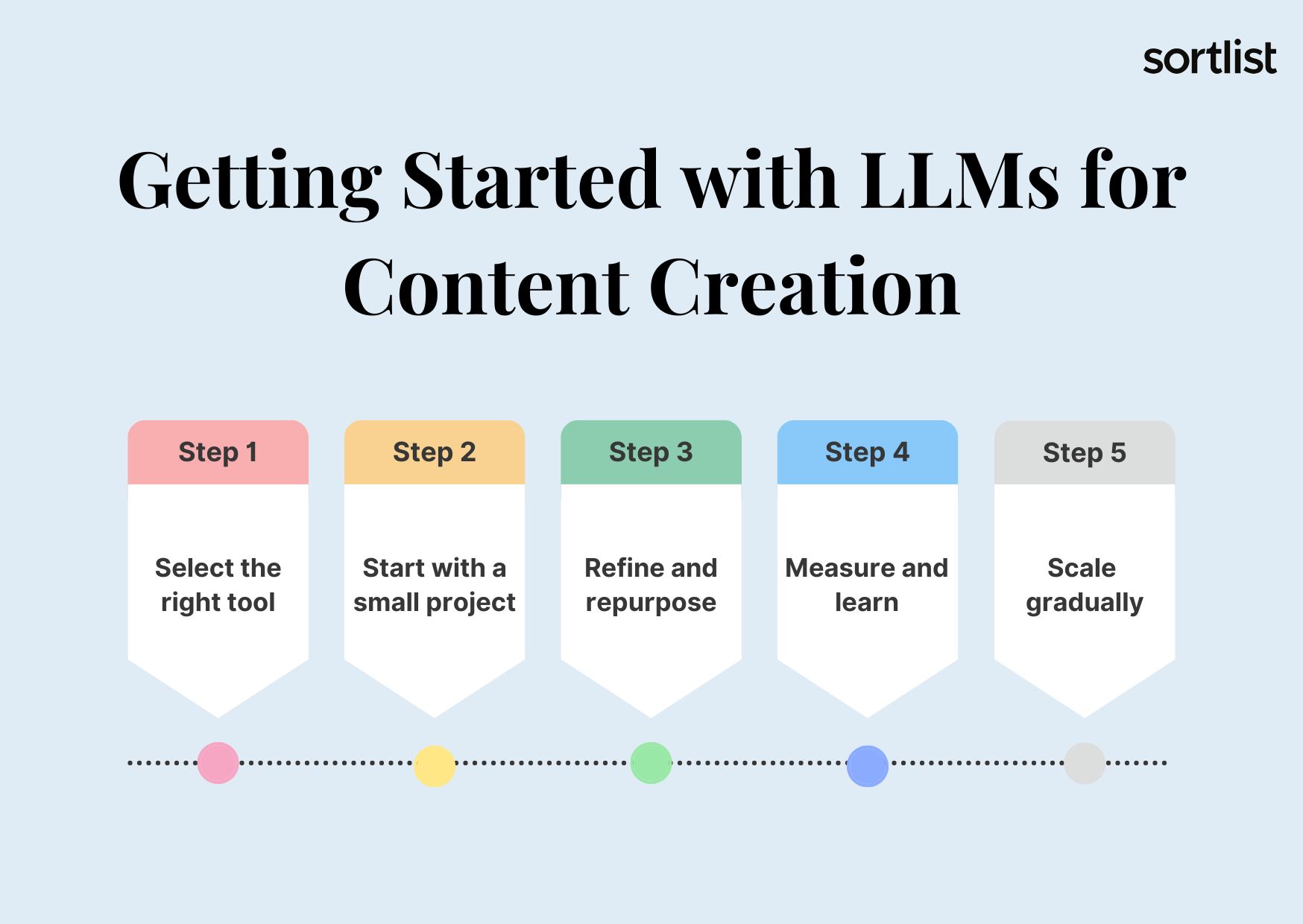
- Select the right tool: Begin with one AI platform that suits your needs. ChatGPT and Jasper are popular choices for marketing content. Focus on usability and integration with your current tools.
- Start with a small project: Test the AI on a single task, such as drafting a blog post outline, an email sequence, or a social media campaign. Keep it manageable and measurable.
- Refine and repurpose: Once the AI produces a draft, refine it to align with your brand’s voice and standards. Then, repurpose the content across channels, such as blogs, newsletters, and social media posts, to maximize the value of one piece of content.
- Measure and learn: Track performance metrics such as engagement, conversions, and time saved. Use these insights to adjust prompts, workflows, and content strategies.
- Scale gradually: As your team gains confidence, expand the use of LLMs to more content types, campaigns, and channels. Maintain human oversight to ensure quality and relevance.
Following this structured approach allows businesses to efficiently integrate LLMs, achieving faster and higher-quality content production without complicating workflows.
Advanced Tactics for Leveraging LLMs in 2025 for Content Creation
Once your team is comfortable with the fundamentals of AI-assisted content creation, it’s time to transition to more strategic and sophisticated approaches that maximize efficiency and impact. These tactics help businesses maximize the value they get from LLMs without sacrificing quality or creativity.
- Prompt engineering: The quality of AI output depends heavily on the instructions it receives. Marketing teams can guide LLMs to produce content that aligns with brand voice, target audience, and campaign goals by crafting clear, detailed prompts.
- Multichannel repurposing: A single AI-generated blog post can be repurposed into content for various channels. Convert it into social media updates, email newsletters, landing page copy, or ad variations. This approach increases reach while saving time and maintaining consistent messaging.
- Hybrid human-AI workflows: The most effective teams combine the efficiency of AI with human oversight. LLMs handle repetitive drafting tasks while humans focus on strategy, editing, and creative refinement. This ensures that the content is high quality and scalable.
- Experimentation and optimization: Use LLMs to quickly generate multiple variations of headlines, calls to action, and campaign messages. Test different versions, analyze performance, and iterate. This approach transforms AI into a tool for continuous improvement, not just content production.
Conclusion
In 2025, LLMs are a practical tools that help businesses create high-quality content faster, maintain consistency, and efficiently scale campaigns. LLMs provide measurable benefits to businesses of all sizes, including time savings, improved ROI, and the ability to focus on strategy and creativity rather than repetitive drafting tasks.
The key to success lies in balance: Use AI to streamline content creation, but always combine it with human oversight to maintain brand voice, accuracy, and engagement. By thoughtfully adopting LLMs, businesses can stay competitive, reach their audience more effectively, and maximize their marketing impact.
Take the next step today. Choose a reliable LLM tool, start with a small project, and explore how AI can enhance your content strategy.
FAQ
Will AI replace marketing teams?
No. LLMs are designed to assist and scale human work. Marketers remain essential for strategy, creativity, and quality control.
Is AI-generated content good for SEO?
Yes, when properly edited. AI can produce SEO-optimized drafts, but content should be refined for originality, relevance, and readability to rank well.
How do I maintain my brand voice using AI?
Feed the AI examples of your existing content and review outputs carefully. Human editing ensures the tone, style, and messaging align with your brand.
What type of content can LLMs create?
LLMs can draft blogs, emails, social posts, product descriptions, ad copy, and even brainstorm ideas for campaigns. They are versatile tools for nearly any written content.


