Why Long-Term Agency Partnerships Outperform One-Off Projects

Every business has hired an agency for a one-off project at some point. A website redesign, a launch campaign, a batch of ads for a product. The project gets done, the invoice gets paid, and both sides move on. Clean, simple, contained.
The problem is that transactional work rarely leads to transformational outcomes.
81% of agency leaders say strong client relationships are the single biggest factor in retaining accounts, ranking above campaign performance and communication quality combined.
An agency that knows your business deeply does better work than one that only knows your brief.
This article examines what that looks like in practice and why it matters more than most businesses think.
The Learning Curve Is Real, and You Pay for It Every Time
(Self-designed)
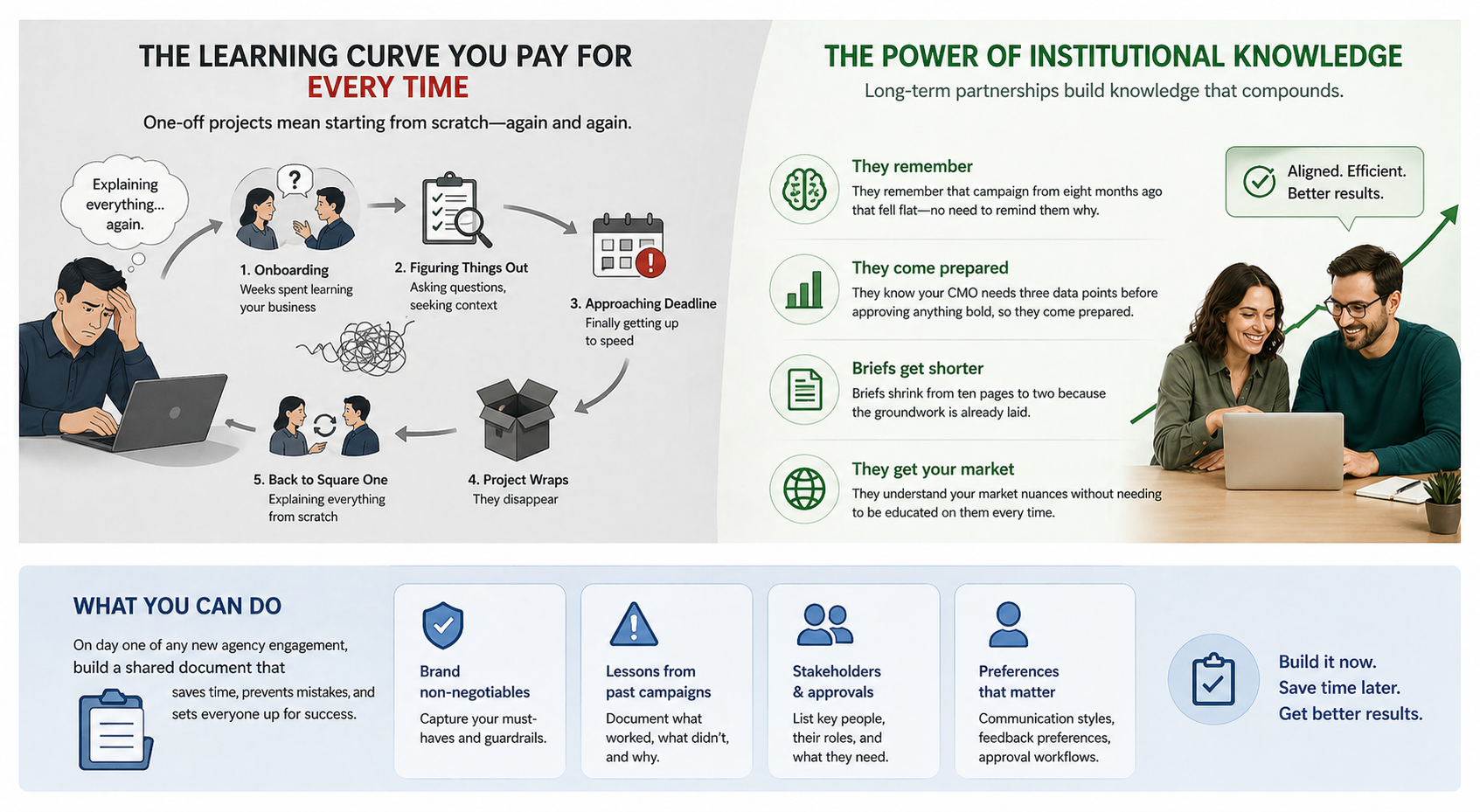
The first few weeks of any new agency engagement are rarely productive in any meaningful way. The agency is learning things about your business that you forgot you even had to explain. Brand voice, internal politics, who signs off on creative, what your audience responds to, and what bombed last year. Some of that gets captured in a brief. Most of it does not, and no brief ever fully captures the unwritten rules of how a business works.
By the time they are up to speed, you are already approaching the deadline. Then the project wraps, they disappear, and three months later, you are explaining everything from scratch to someone new.
Long-term partnerships skip that recurring tax.
Here is what institutional knowledge looks like in practice:
- They remember that campaign from eight months ago that fell flat, and they do not need you to remind them why
- They know your CMO needs three data points before approving anything bold, so they come prepared
- Briefs shrink from 10 pages to two because the groundwork is already laid
- They understand your market nuances without needing to be educated on them every time
What you can do:
When you decide on any new agency engagement, on day one, build a shared document. This document should capture your brand’s non-negotiables, lessons from past failed campaigns, and the names and preferences of every stakeholder involved in approvals.
Do not wait until something goes wrong or doesn’t perform as expected.
Strategy Gets Better When There Is Time to Build It
One-off projects start with a deadline and work backwards. Strategy is an afterthought because the clock is already running.
Long-term relationships flip that. An agency working with you for 12 months starts caring about your annual targets, not just the current brief. They connect dots between campaigns. They spot patterns in your audience that someone parachuting in for one project would never see.
This is where partner marketing thinking moves beyond campaigns and into the agency relationship itself. A long-term agency partner is not merely executing tasks; they are co-investing in your growth.
What you can do:
- Schedule a quarterly strategy session with your agency that is separate from campaign reviews
- Ask them to bring one proactive idea per quarter that you did not brief them on
- Share your company’s annual goals so they can align their work to something bigger than individual deliverables
Trust Unlocks Better Creative
Most agencies, especially early in a relationship, default to safe. They do not know how much creative latitude they have. They do not know whether you welcome bold ideas or prefer to stay close to what has worked before. So they hedge.
That hedging produces competent work. It rarely produces work that stands out.
When an agency has worked with you long enough to understand your risk appetite and expectations around originality, the dynamic begins to change:
- They pitch the concept they genuinely believe is right, rather than the one they think you will approve of
- They push back when a direction will not serve your goals, because they have enough relationship equity to do that
- They bring references and inspirations from outside your category because they understand what you are trying to build
- Creative reviews become conversations rather than approval processes
What you can do:
Tell your agency explicitly how much creative risk you are comfortable with. Give them one brief per year where they have full creative freedom within a defined objective. See what happens. The output usually surprises people.
Continuous Learning Strengthens Both Teams
Long-term agency partnerships include ongoing training, process alignment, and shared workshops as the relationship grows. Teams on both sides develop shared methodologies. New members on either side get onboarded into existing frameworks rather than starting from scratch.
The challenge is making that learning stick.
A digital badging platform can help you with that. When both teams complete shared certifications or learning paths together, participants walk away with a verifiable credential they can display on their LinkedIn page.
The partnership gets a paper trail of real investment that no project brief can replicate. Learning becomes something people show off rather than something they sit through.
What you can do:
- Write a shared onboarding doc for anyone new who joins either team, so they are up to speed in days instead of months
- Plan at least one joint session per year where both sides focus on process rather than output
- Use digital credentials to recognize completed learning so the investment in development is visible and valued
Communication Gets Faster Than You Expect
(Self-designed)
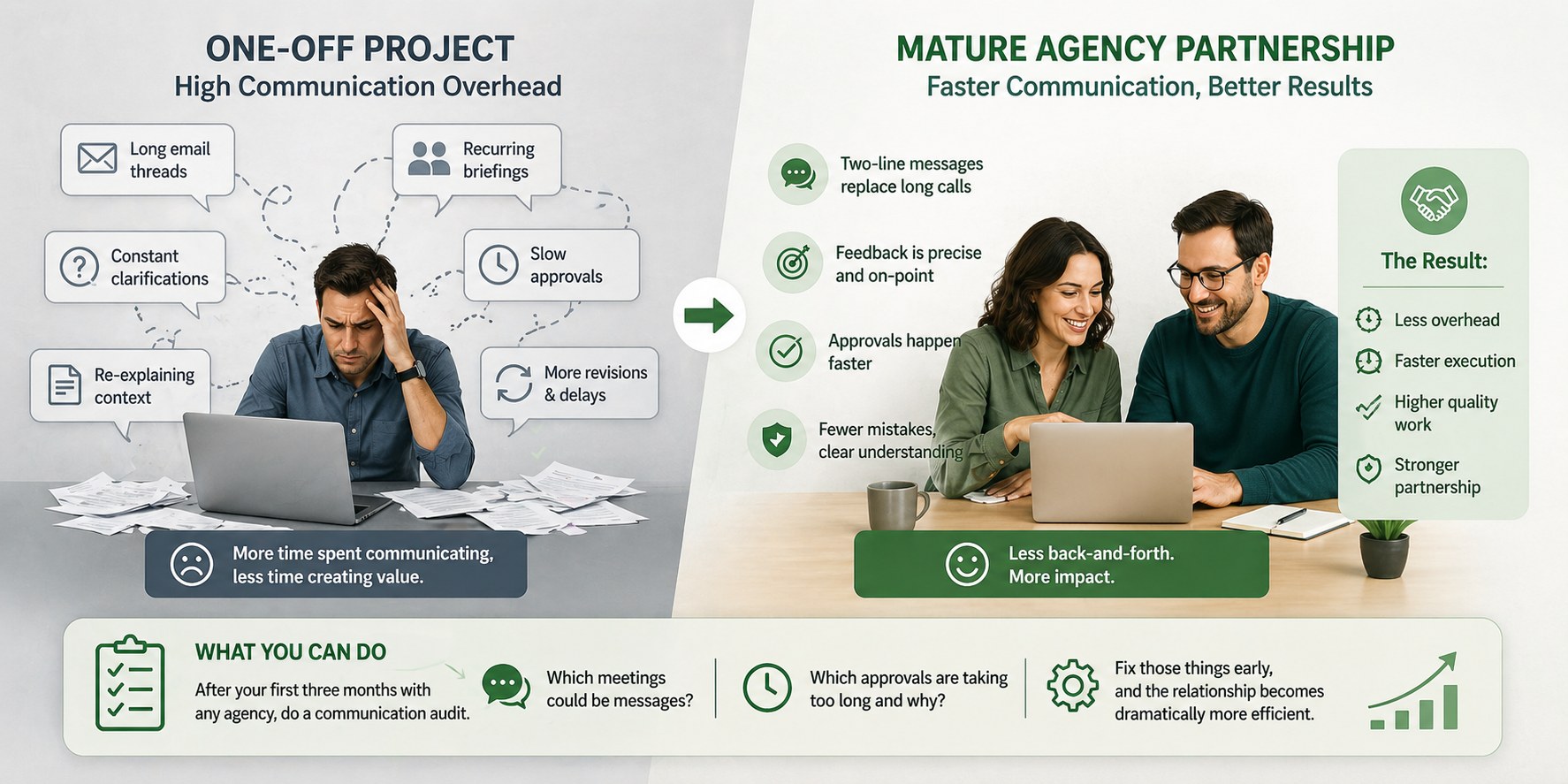
Nobody talks about this enough, but the communication overhead of a one-off project is significant. Every exchange requires context. Every decision needs explaining from scratch. You spend time in briefings that a longer-term partner would not need.
In a mature agency partnership, communication becomes shorthand:
- A two-line message replaces a forty-five-minute briefing
- Feedback lands more precisely because both sides have calibrated their language over time
- Approvals move faster because the agency knows what you are looking for before they submit anything
- Mistakes from miscommunication drop sharply because the working relationship has built-in clarity
Understanding how to structure effective communication with a service provider is a skill that both sides develop. The early investment pays off in speed and quality for every project that follows.
What you can do:
After your first three months with any agency, do a communication audit. Which meetings could be messages? Which approvals are taking too long and why? Fix those things early, and the relationship will become dramatically more efficient.
Long-Term Partners Advocate for Your Business
An agency that has worked with you for two years is not just a vendor. They are invested in your success in a way a project-based agency cannot be. They celebrate your wins. They feel the losses. They talk about your business with genuine enthusiasm because they understand it well enough to care.
This shows up in ways that are hard to quantify but real:
- They introduce people who could be valuable partners or clients
- They think about your business between projects, not just during them
- They go beyond the scope of a brief when they see an opportunity worth flagging
- They bring their best people to your work because they want to, not because they have to
That advocacy comes from the kind of relationship that one-to-one marketing thinking describes well: when you treat the other party as a genuine partner with shared stakes, they respond accordingly.
The Real ROI of Long-Term Partnerships
(Self-designed)
The upfront logic of one-off projects seems proper. You pay for what you need and when you need it. You are not locked into a contract.
In reality, the cost of constantly sourcing, onboarding, and briefing new agencies adds up faster than most businesses track. Most finance teams never see it as a line item, but it is real.
Here is what the cost comparison looks like:
- One-off model: Recurring onboarding costs, inconsistent quality, slower ramp-up, and higher revision rates
- Long-term model: Single onboarding investment, compounding knowledge, faster execution, and fewer revisions over time
There is also the cost of work that does not land because the agency did not know enough about your business to get it right. The campaign was revised three times because the brief was misread. The launch underperformed because the agency could not anticipate how your audience would respond.
What you can do:
Track the total cost of each agency engagement. This might include briefing time, revision rounds, and internal review hours. Compare that against a longer-term retainer. For most businesses that do this honestly, the numbers shift significantly.
Accountability Becomes Structural
When an agency is only with you for one project, accountability is transactional. They deliver the work, you pay the invoice, and whatever happened, happened. If a campaign underperformed, there is no ongoing relationship to examine why.
Unlike this, long-term partnerships create accountability that runs in both directions:
- If something does not work out, there is a next project to apply that learning to
- Performance conversations happen within the relationship rather than as a formal post-mortem
- Both sides have an incentive to be honest about what is and is not working because they will be working together next month, too
This is where building a strong partnership marketing foundation pays dividends beyond any individual campaign. The relationship itself becomes the mechanism for continuous improvement.
The Best Agency Partnerships Are Not Accidental
Everything in this article comes back to one thing: an agency that knows you well does better work than one that does not, regardless of how talented they are. The skills are not the differentiator. The relationship is.
The difference between a superior agency and an average agency partner is rarely about skill. That kind of shared knowledge takes time. There is no shortcut to it and no brief that replaces it.
Finding the right clients to build long-term partnerships with is the hardest part. Sortlist connects agencies with high-intent buyers through outbound campaigns and is one of the most active agency marketplaces around.
If you want a steadier pipeline of clients worth keeping, it deserves a closer look.