


SEO for Doctors: Top Strategies to Enhance Online Visibility

Last update: 18 March 2026 at 08:33 am
In many cases, the Internet is the first place patients turn to seek medical advice, information about a symptom, or even to find a local healthcare provider. No wonder more and more physicians are looking to improve their digital footprint every day. SEO for doctors has become a must and through these lines we tell you why and share some tips on how to implement it.
What is SEO for Doctors?
SEO for doctors refers to the process of optimizing a doctor’s online presence to improve their search engine rankings and attract more targeted patients to their website. This process is made up of various actions including on-page SEO, off-page SEO, technical SEO, and local SEO. All of which we will explore later in this article.
Why Doctors Need SEO?
There are two specific reasons why your practice can’t survive without SEO, especially if you want to increase the number of patients you see.
Understanding Patient Search Behavior
Working with search engine optimization involves a variety of activities designed to help you better understand who your patients are and how they behave online.
First, you need to stop for a minute and create your buyer persona, or the profile of your ideal patient. Include information about their age range, gender, location, interests, reasons for consulting, and more. Putting this in writing will help you have a better idea of who is coming into your practice and who you want to see.
Then you need to think about the common reasons they stop coming in and how you can convince them otherwise.
And you need to spend some time analyzing how they behave online. What are they looking for, where and why?
Insights that will help you attract more people and give them a better and more personalized experience.
Connecting with Community Patients
At the same time, these efforts allow you to connect with potential patients in the community who have never heard of you and whom you can help. It’s the perfect way to attract new paying patients and help those in need.
How Can the Doctors Benefit From SEO?
As a physician, you may not feel connected to marketing terms like “lead generation,” “website authority,” and “search engine friendliness”. Our job is to help you understand why they are important and have a huge impact on your business.
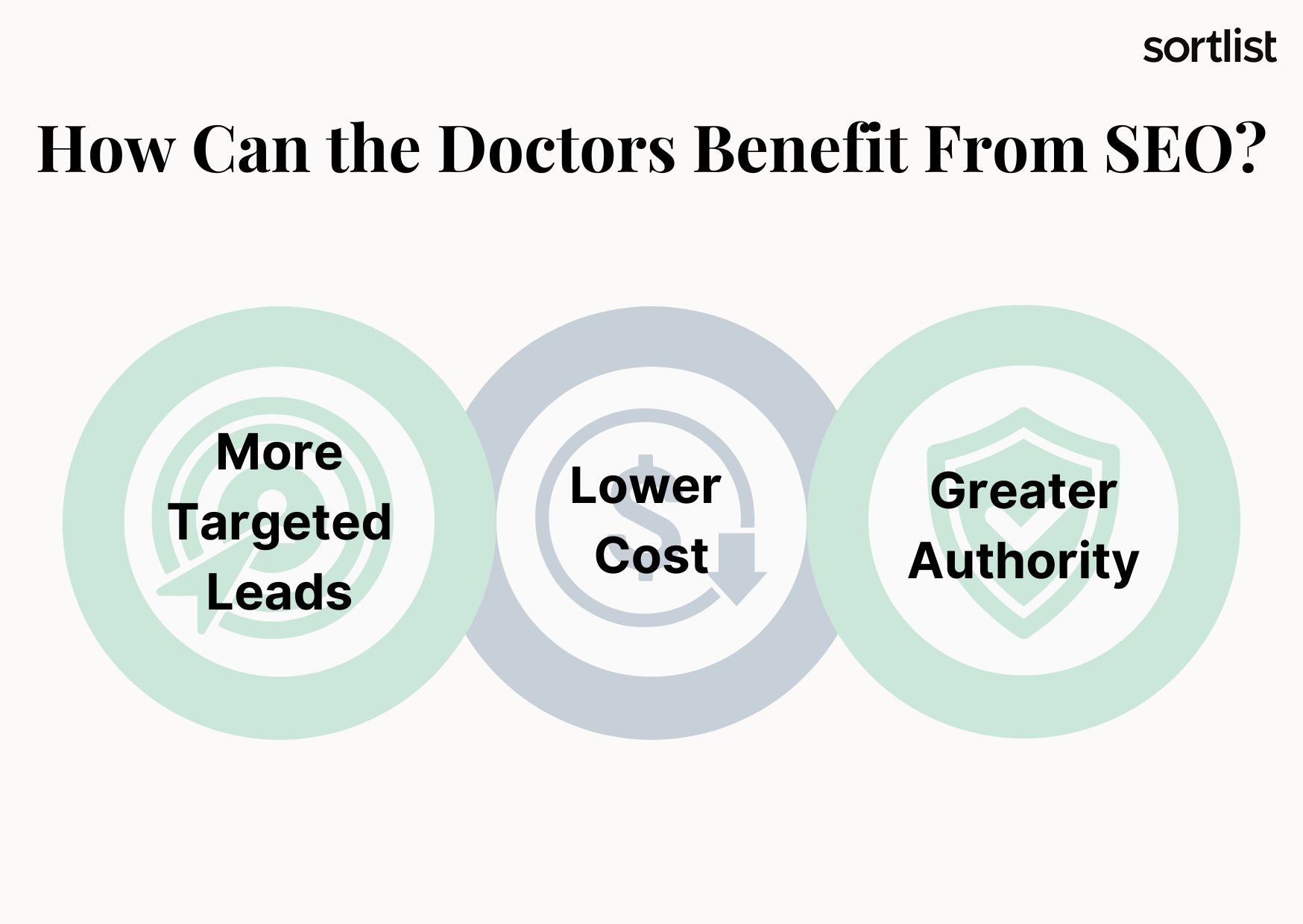
Let’s start with the fact that if no one knows who you are, your specialty, or the types of diseases you treat, then no one will come to you. It is as simple as that. Search engine optimization allows you to tell the world exactly those answers and make them available to your target patients and other doctors who can refer people to you.
That said, let’s look at the 3 main benefits you’ll get when you start implementing a careful and targeted SEO strategy. Remember, you don’t have to struggle to create and implement it yourself; you can turn to specialized professionals or SEO agencies that have a proven track record of working with other medical practices.
More Targeted Leads
SEO for doctors revolves around two main points: creating valuable content and optimizing your site for search engines. These two efforts are designed to get your website ranked among the first results in Google pages.
They increase the chances that highly targeted people will click on it and visit your site. Once they land on your site, they will find answers to their most important concerns and questions, and are most likely to give you their contact information or even book an appointment.
Lower Cost
You can think of SEO as a giant billboard advertising your services to a large number of people who are actually interested and looking for what you have to offer. But, of course, at a lower cost than something like this or even paid advertising in Google or social media.
Investing in SEO for doctors means hiring the right tools, professional or agency to take care of your efforts.
How much does medical SEO cost?
On average, doctors spend between $2,000 and $5,000 on SEO. This of course depends on factors such as your competition, location, goals, and the current state of your website’s optimization.
Greater Authority
Finally, the fact that you generate high quality, value-driven content makes it easy for other sites to link to it. This sends great signals to Google that help improve your ranking in the search results pages and increase the chances of sending better targeted traffic to your site.
How is SEO Used in Healthcare?
With that in mind, here are three key points you need to consider before implementing SEO for doctors best practices.
Set SMART SEO Goals
Before you do anything, you need to decide what you want to achieve with your SEO investment. Some of the most common SEO for doctors goals include:
- Increase organic traffic
- Reduce bounce rate
- Generate leads
- Earning backlinks
- Ranking for specific keywords
- Improving page speed
- Increase brand awareness
- etc.
But you want to set them using the SMART framework. In short, your goals should be specific, measurable, achievable, relevant and time-bound.
For example, instead of just saying you want to generate leads, your SMART goal would be to “We want to increase leads from organic search by 50% over the next 12 months”.
Conduct a Website Audit
Then you want to perform a website SEO audit. It will help you understand how healthy or not your current site is, and what improvements you need to prioritize. Make sure your audit includes
- Website structure
- Content quality
- Mobile friendliness
- Page speed
- Keyword optimization
- Backlink profile
- and more.
Do not feel overwhelmed, you can always hire an SEO agency to perform the SEO audit and present you the final recommendations and data support. Once you have these insights, you can even work with them to implement the changes that will positively impact your site’s performance, user experience, and search engine rankings.
Build an Effective SEO Strategy
At this point, you already know what you want to achieve and the current health of your site. Now it’s time for you or your SEO agency to sit down and start creating your SEO strategy.
It should include all the different actions that will help your site rank in the search engines and achieve your goal. It should also include the various KPIs that you will use to monitor results and make decisions.
In the next section, we give you a list of ideas and tips to help you build an industry-specific SEO strategy.
10 SEO Tips for Helping Doctors Websites
This list of tips is designed to help you understand how to implement each SEO action item. While most of them are fundamental to improving your site’s rankings and results, you can’t focus on them all at once. Prioritize them based on your site audit and your goals.
Improve Your Web Design
The first thing you want to do is improve the design of your website. This is your most important marketing asset, serving as a digital billboard that promotes your services and delivers valuable information to your target patient.
You want to make sure:
- Contains accurate medical images.
- Secured with an SSL certificate.
- Designed for mobile devices.
- Has your name, address and phone number on a dedicated contact page and in the universal footer.
- Includes positive reviews and comments from your patients.
- Remove outdated and underperforming pages.
- Include a blog with engaging content that helps you connect with your patients and establish yourself as a thought leader.
We highly recommend working with a specialized agency that knows what needs to be done and has the right tools to do it.
Claim and Optimize Your Google My Business Profile
Next to your own website, Google My Business is one of the most common places patients look for information about a medical practice or a specific doctor. You want to have your information there because it allows you to share details in one place, such as
- Name
- Phone number
- Physical address
- Practice website
- Services provided
- Business hours
- Reviews and ratings
- Your comments
- Pictures
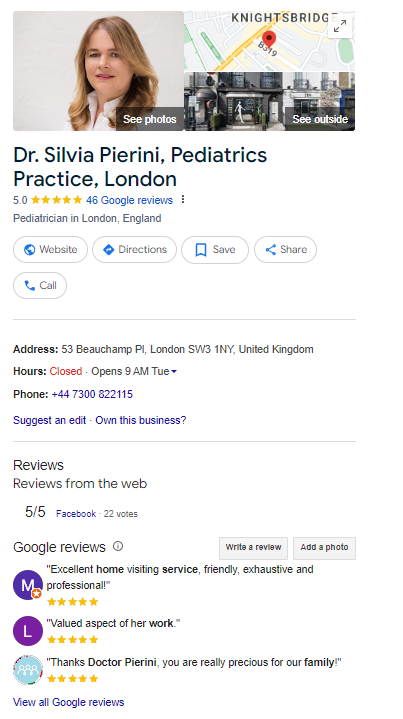
To claim your Google My Business profile, please read our article Best Google My Business Strategy For Your Digital Marketing. Once you’ve created and verified it, it’s time to optimize it and improve its performance:
- Enhance content with relevant medical keywords.
- Provide accurate and up-to-date information.
- Encourage patient reviews.
- Use Google My Business messages to communicate with your customers.
Look for Online Reviews from Your Patients
Your patient reviews are an invaluable asset that helps convert potential patients into paying patients. Think about how you make a purchase decision. You usually ask someone who has tried the product or service for their comments, right? The same happens with a medical practice, people tend to look for different opinions from previous patients before making an appointment.
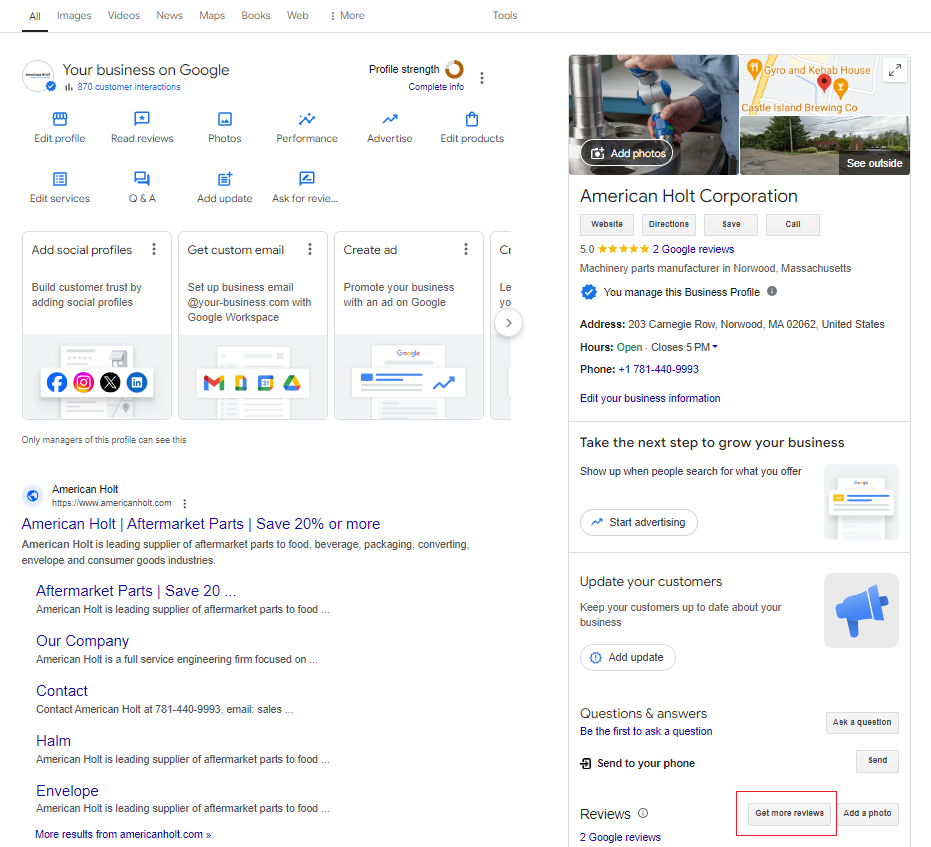
Ask your satisfied patients and/or their families to provide a review. You want to make the process easy for them, so send them an email with a direct link to the review. You can get this link from your Google My Business profile:
- Search for your business in Google Search and click on the link that shows the number of reviews you have.
- Then select the “Get more reviews” button.
- There’s your Google reviews link! Copy and paste it into a text message or share it via email, WhatsApp, or Facebook.
The more reviews you get, the better for your business.
Add Your Practice to Local Listings and Directories
In line with the previous 2 steps, you will want to spend some time searching for medical directories and listings in your area and submitting your practice contact information. While this process may seem time consuming, it actually has a huge impact on your reach and online visibility. It will help you get your name in front of more potential patients and generate more business.
To find local directories and listings, simply go to Google and type in medical directories and your area of service. Go to each site and look up the process for getting listed. The more you get listed, the better.
Your goal here is to attract more of the users searching for queries like “dermatologist near me” or “pediatricians in [area]”.
Conduct Keyword Research
Performing keyword research allows you to understand what searches your patients are doing on Google and other search engines to find medical practices like yours.
It provides key information such as search volume and domain authority for each keyword, so you can determine which ones to use to optimize your site and generate new content.
There are several types of keywords you can use, but we highly recommend starting with long-tail keywords. These are less competitive terms with smaller amounts of monthly traffic such as ‘what does practice management software do‘. For example, assuming you are a pediatrician, you can create content around “adolescent medicing specialist”.
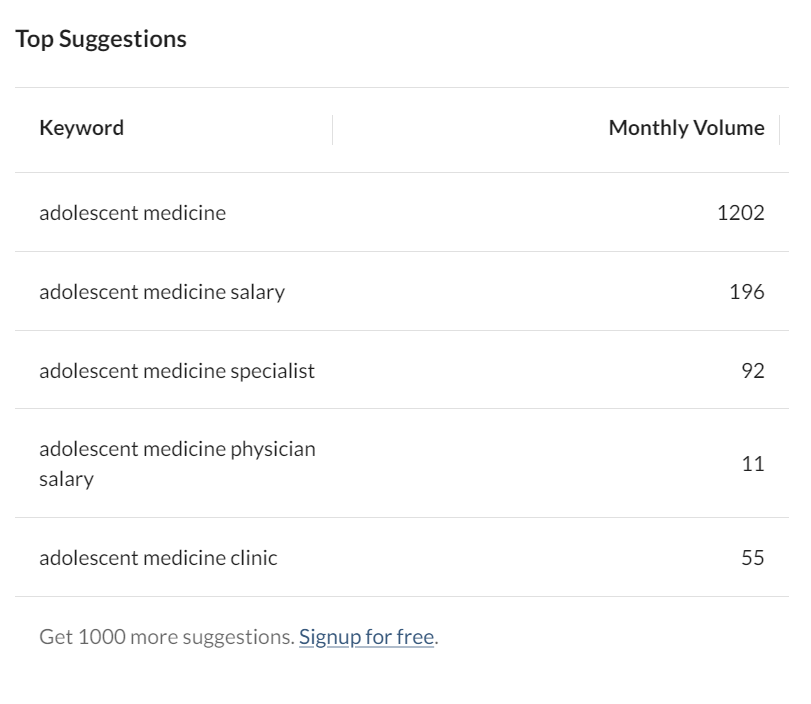
Keep in mind that you will need to work with specific keyword research tools to do this research. While there are many options on the market, we recommend that you work with one of the following: Google Keyword Planner, Soovle, Ahrefs, Keywords Everywhere. In our article “Popular and Best Keyword Research Tools for SEO” we’ll detail how each one works and what the benefits are.

Optimize for Local Search – What is Local SEO for Doctors?
You also want to focus on local keywords; they help you attract searchers who are looking for doctors “near me” or in a specific area. Optimizing for local search is a powerful marketing technique that can help local businesses increase in-store traffic and sales.
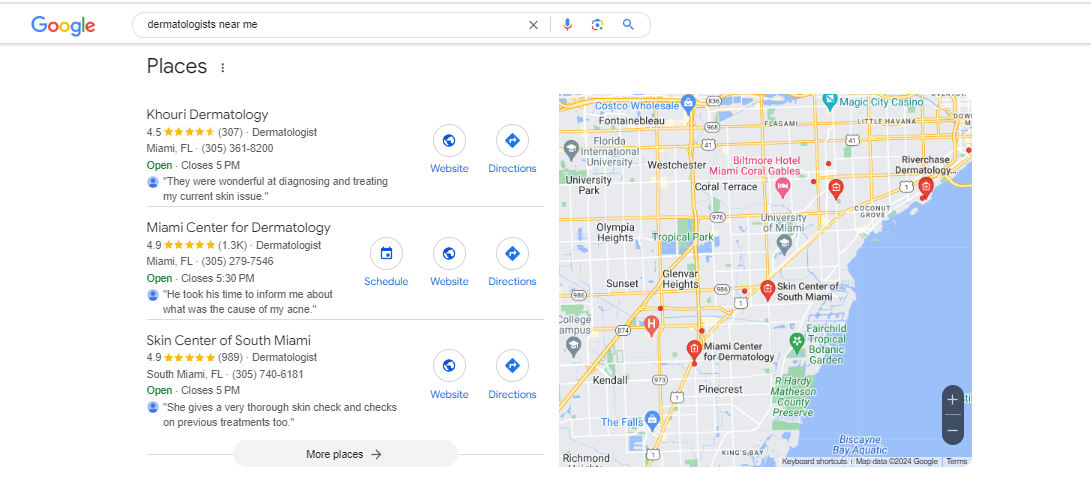
This process, along with your Google My Business profile and local directories, helps you increase your online visibility, build trust, and gain a competitive advantage over other medical practices in your area.
We recommend that you take the time to understand what search terms people are using and incorporate those keywords into your content, website, landing pages, Google My Business profile, and more.
Design and Launch a Content Marketing Strategy
Now that you know the different keywords you should start ranking for, it’s time to create a content marketing strategy. This means that you need to carefully spend time creating, optimizing, publishing, and distributing valuable content to attract new visitors to your site and rank in the search engines.

In other words, your content marketing efforts must work hand in hand with your SEO efforts. To learn more about how content marketing can help your SEO efforts, read our blog post How Content Marketing and SEO Work Together for Maximum Impact.
Work with content hubs
Creating and optimizing content on specific topics helps inform both your audience and search engines that you are an expert in that particular area. For example, if you are a dermatologist, you can create a content hub on how to protect your skin from the sun. And if you are a pediatrician, you can create one about introducing solid foods to babies.
Publish content for people
You want to write content that matches your patients’ search intent, answers their questions, and provides insights they will find interesting.
Answer your audience’s questions
Your content marketing efforts need to answer your audience’s questions. Whether it’s a blog post, video, newsletter, or infographic, you need to provide answers that are filled with valuable insight and information.
Consider Google’s E-E-A-T acronym
Your content marketing efforts need to revolve around Google’s E-E-A-T. This acronym stands for experience, expertise, authority, and trustworthiness. It’s the perfect way to ensure that every piece of content you publish meets quality standards.
Stay on top of your content calendar
Publish content regularly; there is no set number of pieces you must publish each week or month. But it’s a known fact that this practice will help you send more signals to Google and quickly rank for more searches.
Audit your backlinks and look for more
Audit your backlinks and look for more. To perform the audit, you’ll want to use tools like Moz’s Link Explorer. They are designed to give you information on how many backlinks your site has, what they are, and the page and domain authority with just one click.
Optimize for On-Page SEO
Once you have your content pieces ready, it’s imperative that you optimize them according to on-page SEO best practices. This will help make them readable and indexable by search engines and improve your rankings, attract more organic traffic, and convert more visitors into patients.

Some best practices include
- Optimize meta tags and meta descriptions by including your focus keyword and making them descriptive of your content.
- Distribute content with relevant header tags.
- Improve your URL structure by making it unique and including your focus keyword.
- Add internal links to other relevant content on your site.
- Optimize your images by adding description, title and ALT text.
To read more about on-page optimization, please visit our dedicated blog post The Ultimate 2024 Checklist for On Page SEO Services + Examples.
Earn Backlinks
A great way to increase your online visibility and website traffic is to earn backlinks from other authoritative and relevant sites in the medical industry.
Some ideas that will help you in this linking process are:
- Writing guest blog posts.
- Identifying unlinked brand mentions and asking them to add the link.
Share your expert advice on podcasts, websites, webinars, YouTube and media outlets.
Our Off-Page SEO Checklist for 2024: Boost Your Rankings will help you understand how to implement each action item.
Optimize Your Site Speed, Security and User Experience
It’s imperative that every patient who visits your site is greeted with an exceptional user experience. This means that your site loads in less than 3 seconds, has an SSL certificate to secure patient information, and is easy to navigate.

Our “Ultimate Guide to Technical SEO Services” blog posts provide guidance on implementing each of these elements, as well as other details such as the proper use of schema markup, breadcrumbs, and fixing broken pages.
Make Sure Your Site is Mobile Friendly
In today’s world, more than half of Google searches are conducted on a mobile device. With that in mind, medical practice websites should be mobile responsive so that anyone, no matter the size or resolution of their screen, can view and engage with them.
To see if your site is responsive, go to Google Search Console and look for the Mobile Usability Report. It will tell you which pages have problems and what exactly they are.
If it’s not responsive, you should contact your website development team and ask them to fix it as soon as possible.
Take Advantage of Social Media
After all, you want to use social media to your advantage. But before you start creating profiles on every network out there, take some time to understand where your patients spend the most time. If you’re a pediatrician or dermatologist, you’ll most likely find them on Instagram. On the other hand, if you’re a physical therapist, YouTube is probably better for tutorials and explanations. Each specialty has a very specific niche of users, and they all have specific patterns of online behavior.
Once you’ve determined which social media channels to use, you need to start creating posts that will engage and nurture your audience. Use the content from your blog post to do this. Create posts that encourage them to interact. Ask them questions, send them polls, etc.
SEO Services for Doctors
At this point, you are probably wondering how you are going to implement all of these SEO for doctors best practices when you need to spend every minute caring for your patients. We strongly recommend that you get in touch with an SEO agency that has a proven track record of working with medical services.
They will help you create your strategy, perform competitive and backlink analysis, conduct keyword research, and implement on-page, off-page, technical, and local SEO.
Working with an expert guarantees that you will have the time to focus on what you really know how to do, while someone with expertise, experience and tools takes care of your SEO efforts. Most importantly, you won’t be putting this task off for another day. Search engine optimization takes time to produce results, but when it does, watch the phones start ringing and your schedule start filling up.


