

The real price of marketing, and how to make it do more

Last update: 26 March 2026 at 12:16 pm
 5.00/5
A company’s marketing budget isn’t expensive. Paying for the wrong work is.

Companies routinely sink cash into salaries, tools, and “learning time” that never ships.
But even when experts often recommend investing around 2–5% of company revenue in marketing to stay competitive, in practice, many brands either overspend on inefficient in-house efforts or under-invest and miss out on growth.
For any company dissatisfied with current marketing results or unsure whether to outsource or keep it in-house, read on. A small shift in strategy could save you tens of thousands and turn the same budget into more pipeline – with fewer surprises.
(Or if you’re already convinced that marketing is your next move, match with an agency here.)
Budgeting for marketing: a strategic investment
Any CEO or founder thinks of their marketing budget as the fuel for their company’s future revenue and brand equity – not just an expense line.
In fact, companies worldwide typically reinvest around 2–5% of their revenue into marketing.
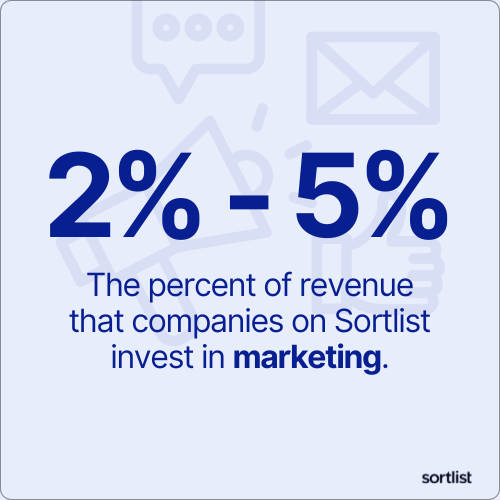
However, it’s a ballpark figure – many successful companies find that investing at the higher end (or beyond) of that range pays off in stronger market presence and customer acquisition.
For example, B2C firms often allocate 5–10% of revenue to marketing, recognizing the need to engage broader consumer audiences.
Benchmarking marketing budgets
It helps to know what similar businesses spend.
According to Sortlist data, the average marketing budget for small companies sits around $31,800. These are businesses with under $2M in annual sales and under 20 employees.
For those with 20-49 employees, the budget doubles to approximately $60,000.
And companies with 50 or more employees tend to have marketing budgets above $100,000.
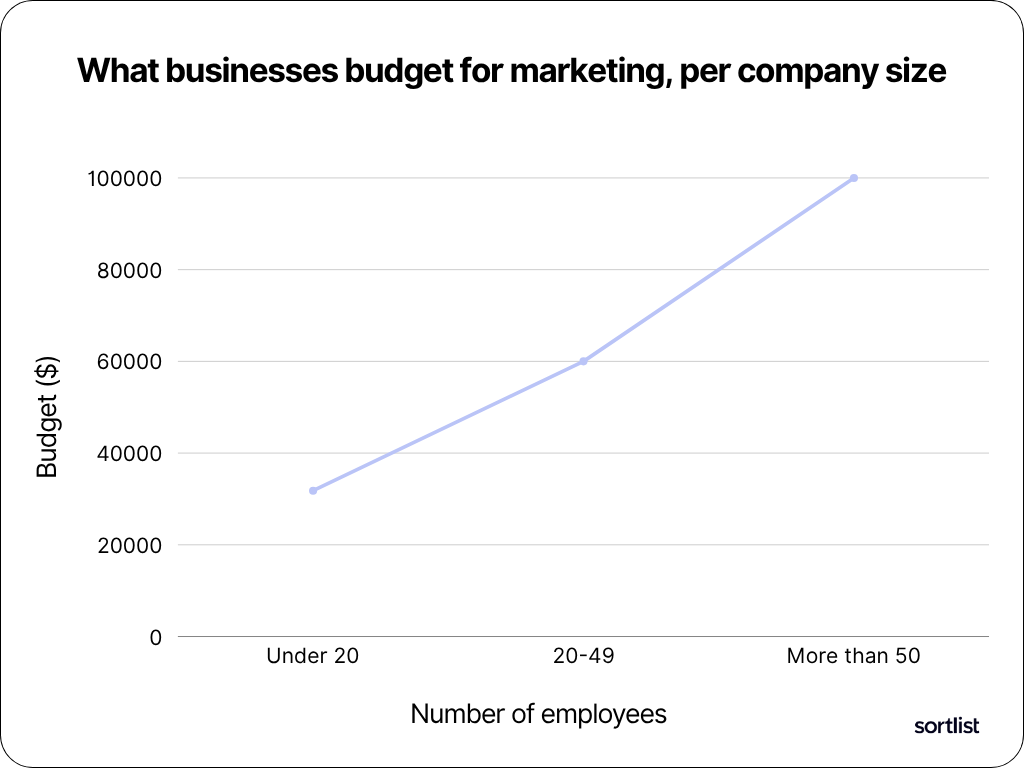
It’s also telling that larger companies invest far more in marketing as a proportion of resources – big firms devote around 13.6% of their total budgets to marketing, whereas small businesses stick to the usual 2–5%.
Takeaway for decision-makers: under-investing in marketing can leave brands at a competitive disadvantage. A Fortune-500-sized budget is not needed to grow, but they do need to spend enough – and spend it smartly – to make an impact.
If you think you’re one of those brands, start now.
What are typical prices for marketing service?
Social media management
Prices can range widely based on the scope and number of platforms. For a basic package (e.g. 2–3 posts per week on a couple of platforms with content creation included), ~$2,000 per month is a common starting point.
A comprehensive social media strategy with daily posting, community management, and paid ad campaigns can cost more – in some cases $5,000-$10,000+ per month for larger brands.
Search engine optimization (SEO)
SEO is a long-term play, and agencies often offer monthly retainers. On average, SEO agency services run between $350 and $2,000 per month, depending on how many keywords and technical fixes are involved.
Content creation and content marketing
Quality content is essential for SEO, lead generation, and brand authority. Many agencies offer content creation packages. For example, website content writing might cost $2,000 to $10,000 per month for ongoing content (blogs, articles, landing pages).
Content strategy and research adds to the cost: thorough content research or auditing can run $5,000 up to $25,000 for larger projects (though basic audits might be a few hundred dollars).
Paid advertising (PPC and social ads)
Running Google Ads, Facebook Ads, or other paid campaigns requires both ad spend and management.
A typical small-business PPC management fee might be $500 to $1,500 per month, and agencies may require a minimum ad budget of a few thousand dollars to be effective.
According to Sortlist data, companies should expect to invest around $9,000 to $10,000 per month on pay-per-click advertising to see meaningful results.
The good news? Agencies managing ads will continually optimize for performance, so companies get the highest return on whatever budget they have.
Design and branding
These services are often one-time project costs rather than ongoing fees (unless continuous design work is needed). A logo and basic brand identity package might range from $5,000 to $15,000 with an agency.
A complete company rebrand (new visual identity, messaging, website redesign, etc.) can cost significantly more. SMBs often budget $15,000+ on rebranding projects on Sortlist.
Website design and development
These can vary widely: a simple business website might be $5k-$10k, while an advanced e-commerce site could be $30k or more.
Outsourcing them is typically much cheaper than hiring a full-time designer or developer, unless there are ongoing web needs.
In-house marketing: are companies paying more than they realize?
Hiring employees to handle marketing in-house might seem straightforward – you control the team and they focus solely on your company.
But the true cost of an in-house marketing team goes far beyond salaries.
- Consider a typical small marketing team for an SMB: perhaps a content writer, a designer, a social media manager, and an SEO specialist.
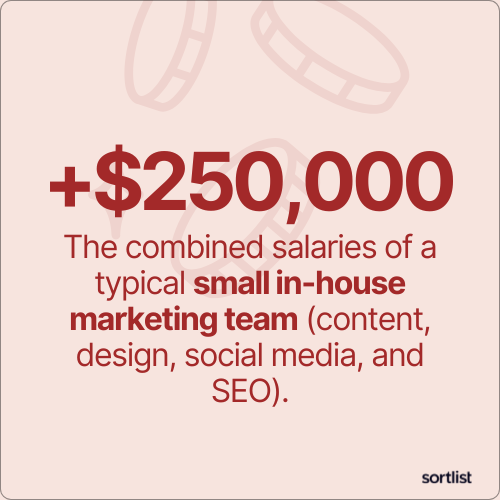
- Even at moderate experience levels, their combined salaries could easily hit $250,000+ per year.
- And that’s before adding benefits, taxes, office space, software, and other overhead.
And to truly cover all marketing needs (content, SEO, social media, design, analytics, etc.), many companies would need an even larger team.
It’s no surprise that the average price of an in-house marketing team can reach about $414,585 per year.
Why is in-house so expensive
Aside from salaries, companies are paying for ongoing training, marketing tools subscriptions, management time, and the risk of staff turnover.
If a team member leaves, they incur recruitment costs and lost momentum. During slower months, businesses would still be paying full salaries even if output dips.
These factors make in-house marketing a fixed, often inflexible expense that many companies struggle to sustain.
Take a look at the massive difference in in-house vs. outsourced costs for those services mentioned above:
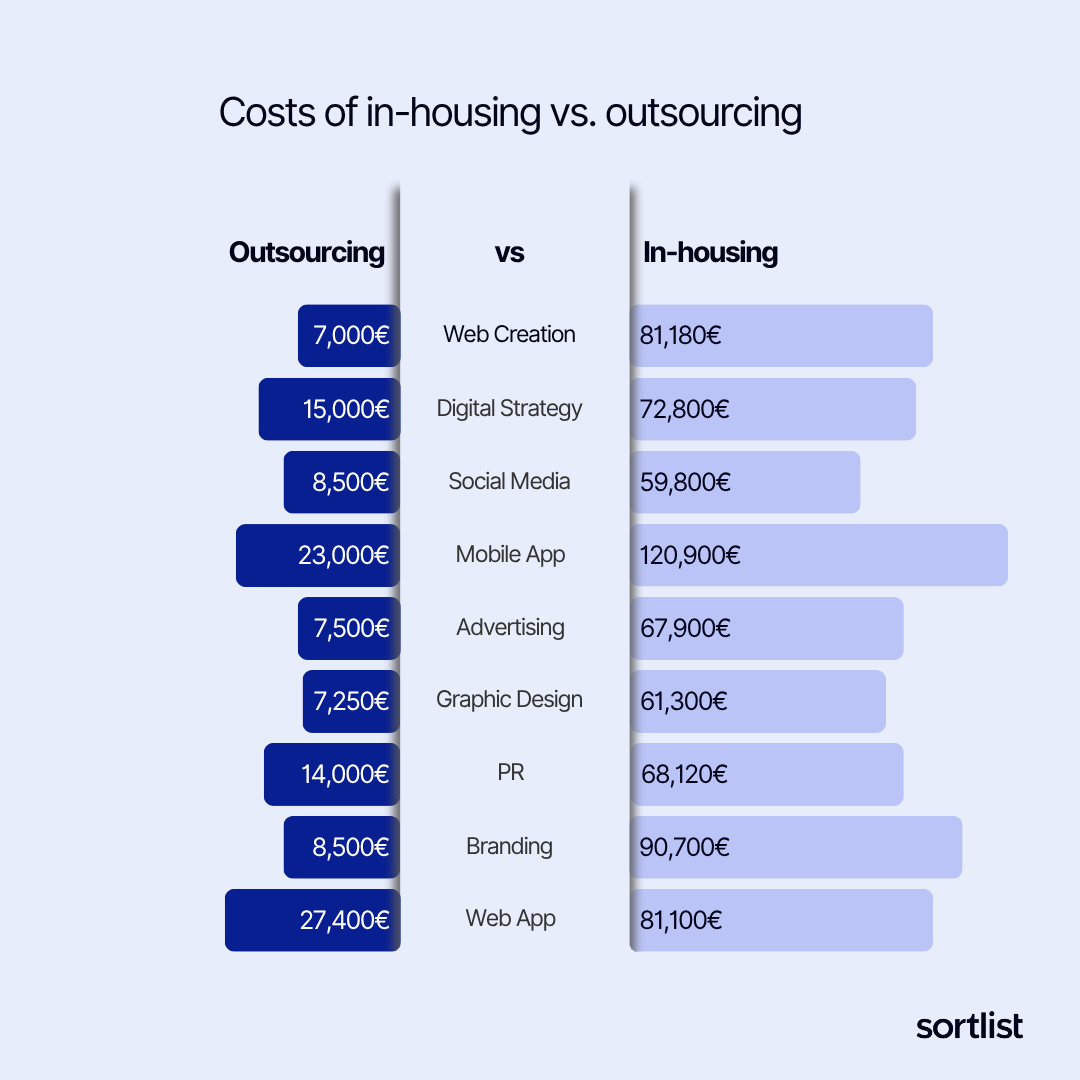
Bottom line: Keeping marketing in-house gives brands control, but it comes at a high cost. Unless their needs are very minimal, an in-house approach means carrying a large, permanent expense. For most growing businesses, it’s worth asking: “Are we getting enough value to justify this cost?“
The alternative, of course, is to outsource marketing to an agency.
Outsourcing to an agency: efficiency at scale
If the picture of in-house costs made you gulp, take heart – outsourcing to a marketing agency can dramatically reduce the cost while delivering better results.
In fact, hiring a marketing agency is about 50% more cost-efficient on average than maintaining an in-house team:
- Shared expertise at lower cost: a good agency comes with a ready-made team of specialists – strategists, copywriters, designers, SEO experts, social media managers, and more.
Companies get access to all those skills for a fraction of the cost of hiring each role in-house.
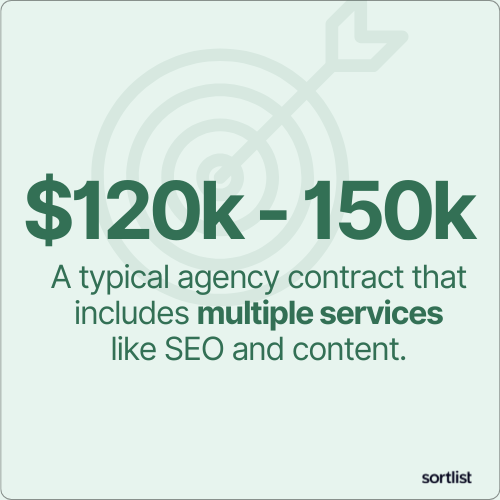
For example, an in-house content/SEO team costing ~$260K/year could be replaced by an agency contract of around $120K–$150K/year, saving well over $100,000.
- Efficiency and latest tools: agencies work on dozens of projects and have refined processes to deliver quality work quickly. They also invest in enterprise-grade tools and marketing technologies (analytics, automation, design software) so businesses don’t have to.
This means faster turnaround times and data-driven campaigns. An agency’s team brings a specialized skillset and up-to-date tools to the table, ensuring work gets done efficiently and with the latest best practices. - Scalability and flexibility: with an agency, businesses can easily scale their marketing efforts up or down based on business needs.
Want to launch a big campaign or add SEO on top of social media? It might be as simple as adjusting your contract. Conversely, if you need to cut back for a month or two, you’re not stuck with idle full-time staff – you can dial down the scope.
This flexibility is huge for businesses. They get a broad team on-call without the long-term commitment of new hires.
What about quality and control?
Some business owners worry an outside team won’t “get” their brand or might juggle them with other clients.
In practice, a good agency will take time to understand the business and integrate with their team’s feedback processes.
Yes, they sacrifice a bit of day-to-day control, but the return is specialized expertise and focus on outcomes.
Many companies find that agencies actually bring more consistency and innovation to their marketing than they could achieve in-house.
Need a custom budget?
Budgeting for overall marketing project is complex. But companies don’t have to go it alone.
Based on data from 250,000 projects, our AI Budget Advisor gives brands a tailored estimate for their next project in minutes.
Try it here.


