

How AI Anticipates Consumer Behavior with Predictive Advertising in 2025

Gone are the days when you or your marketing team had to rely solely on past performance to forecast consumer behavior. Today, in 2025, predictive advertising makes your job easier. It collects, analyzes, and processes vast amounts of data, such as web browsing history, items added to carts, social media interactions, and attributes, to identify and predict future outcomes and behavioral trends in your target audience.
This information lays the foundation for success in terms of better ad targeting, delivery, and advertising campaign optimization.
This blog post will guide you through understanding how predictive advertising works and how it’s transforming global markets. In 2025, this knowledge is critical to staying competitive.
What is Predictive Advertising?
Predictive advertising uses artificial intelligence (AI), machine learning (ML), and big data analytics to forecast future customer behavior. But, how does this work? The predictive analytics, analyzing large amounts of customer data, including purchase history, browsing behavior, demographic trends, and real-time social sentiment, predictive models can identify patterns to help you deliver highly personalized ad campaigns at the right time and through the right channel to the right audience.
But how does it work? Essentially, predictive analytics involves analyzing large amounts of past data, including purchase history, browsing behavior, demographic trends, and real-time social sentiment. These models help identify patterns, allowing you to deliver highly personalized ads at the right time and through the right channel to the right audience.
In other words, predictive analytics allows you and your marketing team to understand which members of your target audience are more likely to convert at a given time. This information allows you to create better, more personalized marketing campaigns and optimize ad copy and ad spending.

For example, just think of Netflix. Its system is designed to provide personalized recommendations by analyzing your viewing history, interactions, and patterns of similar users. This information, combined with what other users watch, can predict what you’ll enjoy. Hence, the success! of the streaming platform.
Why Predictive Advertising Matters in 2025 Marketing Campaigns
For years, marketing professionals have searched for reliable ways to predict what consumers will want next. Thanks to advances in AI and predictive analytics, that vision has become a reality in 2025, and your team is now just one click away from leveraging it. This isn’t speculation; the data speaks for itself.
- The global predictive analytics market is expected to grow at a compound annual growth rate (CAGR) of 21.2% over the next decade, reflecting its increasing importance across industries.
- A MicroStrategy survey found that 64% of organizations credit predictive analytics with improving efficiency and productivity, and 56% report that it enables faster, more effective decision-making.
- Regarding customer engagement, 46% of businesses highlight predictive tools as essential for driving acquisition and retention, and 44% emphasize their role in enhancing customer experience and satisfaction.
The driving force behind this momentum is simple: predictive advertising gives you and your marketing team the ability to turn raw data points into actionable insights. Rather than relying on guesswork, you can proactively optimize campaigns, personalize experiences, and gain a measurable competitive edge in increasingly crowded digital markets.
How AI Anticipates Customer Behavior
The true power of artificial intelligence goes far beyond writing an SEO-optimized blog post in seconds. AI’s power lies in its ability to collect, process, analyze, and transform scattered marketing data into actionable insights.
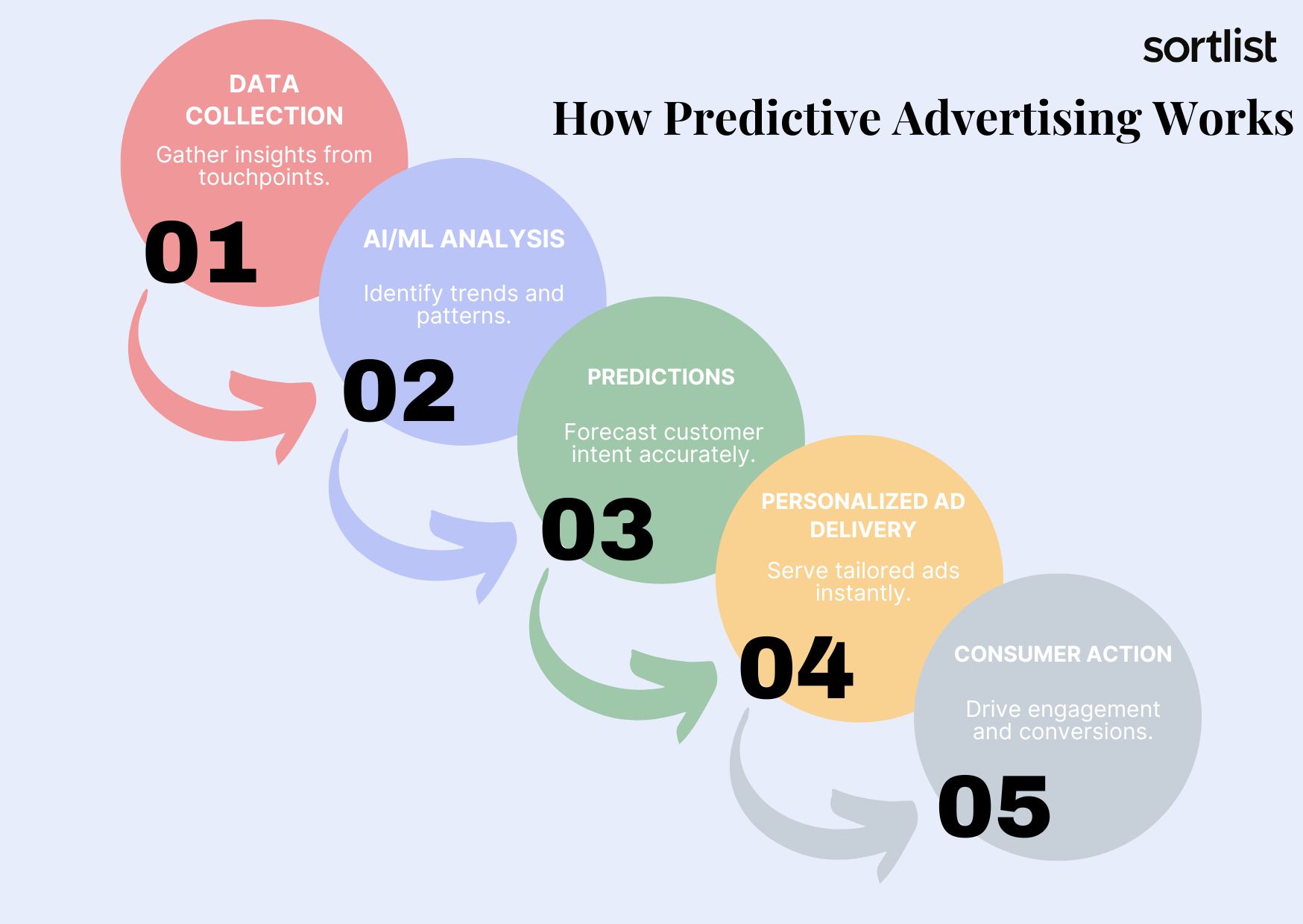
Simply put, AI anticipates customer behavior by pulling data from every corner of the digital world, including browsing history, past purchases, social media activity, CRM systems, and IoT devices. Rather than viewing this information in pieces, machine learning models connect it all and identify patterns and signals that humans would easily overlook. The result? A forward-looking view that explains what your customers did yesterday and predicts what they’re likely to do tomorrow, whether that involves buying, subscribing, or walking away from your store.
However, the real magic happens in how you apply these insights. For example, with AI you and your marketing team can:
- Create personalized recommendations based on customers’ past behavior, as Netflix and Spotify do.
- Create new customer segments based on specific characteristics, such as interests, location, or values.
- Anticipate customer needs and provide proactive customer support.
- Predict specific product demand to optimize stock levels.
- Identify clients at risk of churning.
Every feature serves as a great benefit for companies like yours. On the one hand, it helps you deliver more personalized marketing campaigns and optimize targeting. On the other hand, you can better serve your clients and potential customers, improving their satisfaction and loyalty and preventing them from leaving.
Benefits of Predictive Advertising for Marketing Professionals
By now, you are probably aware of the many benefits of predictive marketing in 2025. It makes sense because you stop relying on assumptions and start making smarter, data-backed decisions that lead to measurable results. Some of these benefits include:
- Hyper-personalized messages and experiences
- Improved customer segmentation
- Optimized budget allocation and campaign timing
- Improved customer acquisition and retention
- Increased engagement and conversions
At Storlist, we’ve been using it for quite some time and have realized that one of the biggest benefits is the higher ROI it provides. Once you start using predictive insights, you can allocate your budget precisely to the audiences and channels most likely to convert. This results in less wasted ad spend, greater efficiency, and a better return on every dollar you spend on your marketing efforts.
We’ve also seen that personalization at scale also has a great impact. Rather than running broad marketing strategies that may or may not resonate with your audience, AI enables you to deliver messages that speak directly to each customer’s interests, behaviors, and intent. The result? Better engagement, stronger customer relationships, and increased loyalty.
Core Applications of Predictive Analytics in Digital Advertising in 2025
That said, it’s important to review how predictive advertising is transforming the way entire industries approach digital marketing. In retail and e-commerce, for example, brands are using predictive analytics to forecast product demand, optimize their inventory, and deliver personalized shopping experiences.

Travel and hospitality businesses, on the other hand, use predictive technology to anticipate when people are likely to book. This allows them to send timely offers and adjust their pricing strategies before customers start their searches. The same is true in finance, where predictive tools help identify when customers are most likely to need loans, credit cards, or investment products.
As you can see, regardless of the industry, the purpose for predictive analysis remains the same: to anticipate needs, take action before the customer does, and create experiences that build trust and long-term value.
Conclusion
By 2025, predictive advertising will be essential. Rather, it will be the foundation of successful digital marketing strategies. By combining AI, machine learning, and big data, you and your team can transition from reacting to customer behavior to anticipating their next moves. This allows you to create more relevant campaigns, provide better customer experiences, and achieve stronger results.
Whether your goal is to optimize ad spending, prevent churn, or uncover new growth opportunities, predictive advertising provides the necessary tools. The question is no longer whether you should adopt it but how quickly you can implement it in your marketing strategy.
To get started with predictive advertising, we highly recommend getting in touch with one of our predictive analytics companies. They have the experience and teams to help you understand and implement data analysis and predictive intelligence to collect data and analyze historical data and enjoy the many benefits that come with it.
FAQ
Is predictive advertising only for big companies?
No, not anymore. Although big enterprises were the first to adopt it, today’s cloud-based platforms have made it affordable and accessible for small- and mid-sized businesses, too.
How accurate are predictive models in 2025?
With clean, real-time data, accuracy rates now reach 60–90%. Accuracy depends on a series of factors, that include data quality and quantity, algorithm complexity, feature engineering, and the specific problem context.
Which industries see the best results with predictive advertising?
Retail, e-commerce, travel, healthcare, and finance currently lead the way, but any industry with customer data can benefit.
What about privacy in predictive advertising?
In 2025, predictive advertising follows global regulations like GDPR and CCPA. The focus is on transparency, consent, and responsible data usage so customers feel their information is safe.
What skills do marketers need to work with predictive ads?
While you don’t need to be a data scientist, you should understand how to read and apply predictive insights. Think of it as combining marketing creativity with data literacy to make smarter decisions and improve campaign performance.


