

10 Brilliant Informative Advertising Examples You Can Learn From

We’ve always heard that there’s no such thing as bad publicity. Most marketers just want people talking about their brand, even if it’s because of a “not so good” campaign. However, in 2025, audiences expect more than just a rush of emotions. They want brands to go the extra mile and help them understand exactly what products or services they’re being sold. That’s where informative advertising comes in.
These digital marketing campaigns and video ads don’t just aim to generate hype among their target audience. They aim to build credibility by providing clear information about a product or service so the audience can make an informed decision.
In this blog post, we will guide you through this important concept, which is especially relevant if you are launching new products or belong to a regulated industry. We will also share some creative campaigns that have mastered the art of informative ads and left a lasting impression on their customer base.
Ready to start? Remember that 50% of consumers today want ads to provide more comprehensive information and teach them something new.
Key Takeaways
- Education drives trust: Modern audiences value transparency and information over persuasion, making informative advertising essential in 2025.
- Storytelling turns facts into emotion: The best campaigns combine credible data with relatable human stories to create lasting impact.
- Visual learning wins: Infographics, explainers, and data visualizations boost understanding and retention, making complex ideas simple.
- Transparency builds loyalty: Backing up claims with data, testimonials, and expert validation turns information into credibility.
- Partnerships amplify success: Collaborating with specialized agencies helps brands design campaigns that teach, engage, and convert effectively.
What Is Informative Advertising?
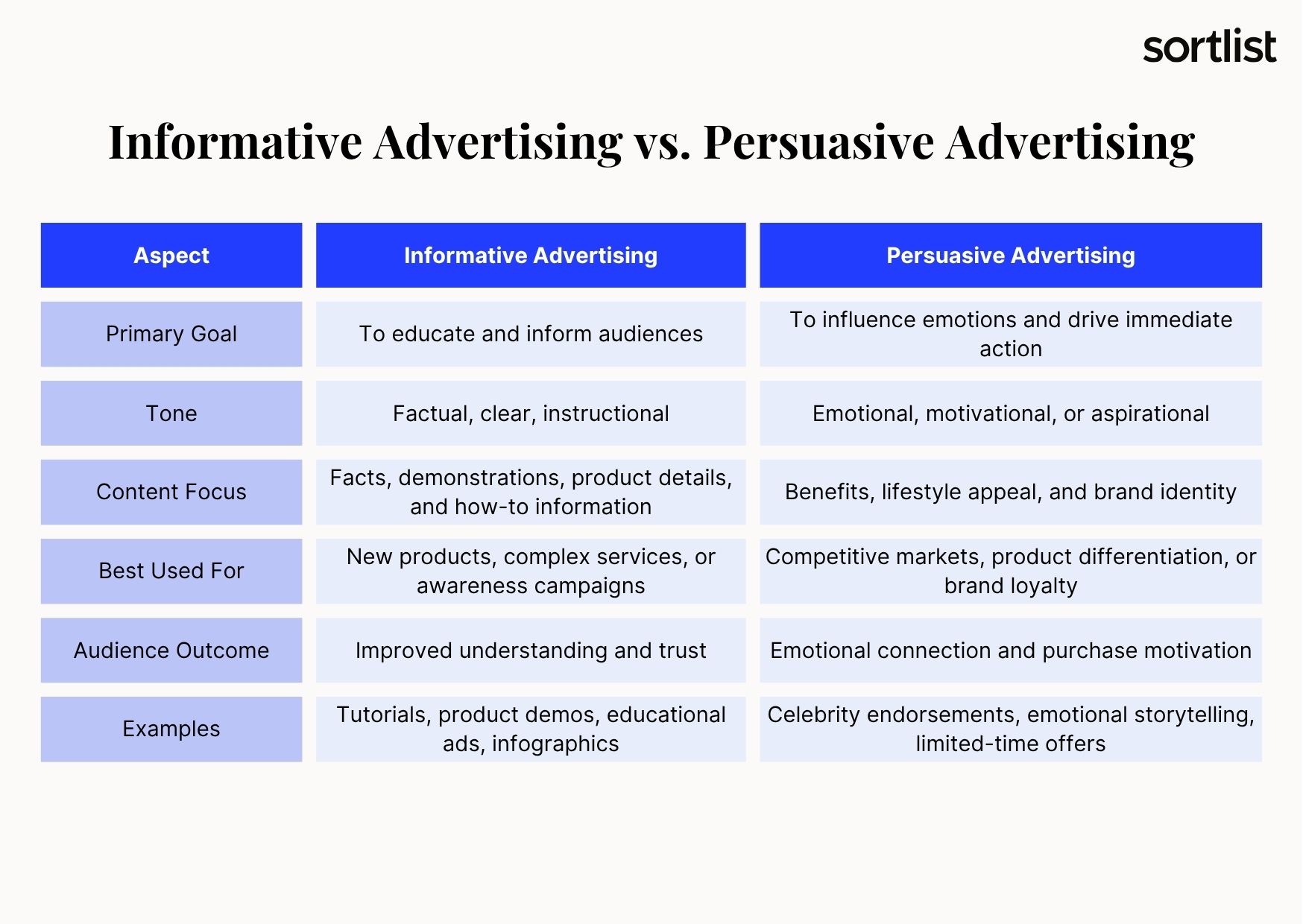
Informative advertising is a marketing strategy that focuses on educating potential customers rather than merely persuading them. These ads provide useful facts, data, and demonstrations about products, services, or issues to help specific audiences make informed decisions.
Unlike emotional or comparative ads, informative advertising campaigns emphasize clarity, accuracy, and credibility. They often include tutorials, infographics, explainer videos, or data-backed campaigns that demonstrate how something works or solves a real problem.
We are confident in saying that informative advertising campaigns come packed with key benefits such as:
- Empowering your audience by giving consumers the knowledge they need to make confident, informed choices
- Building trust and credibility by establishing your brand as a reliable source of information rather than just a seller.
- Reducing post-purchase dissonance helps customers fully understand what they’re buying, leading to higher satisfaction and fewer returns.
- Easing new product launches by simplifying complex or innovative product features and making them accessible to broader audiences.
- Enhancing brand authority by positioning your business as an expert in your niche, improving your reputation, and thought leadership.
10 Effective Informative Advertising Examples
The most effective informative advertisements do more than persuade; they educate, empower, and simplify complex ideas for their audiences. The ten real-life examples featured here were carefully selected for their creativity, credibility, and lasting impact across different industries. Each demonstrates how your brand can leverage education as a strategic advantage to build trust, clarify value, and create meaningful engagement, not just to sell.
These examples are important because they reflect the growing demand for authentic, knowledge-driven communication in 2025. In this era, audiences value transparency and insight over slogans. Whether you’re launching a new product, promoting a cause, or strengthening your brand story, these campaigns offer powerful inspiration on how to turn information into influence and education into emotional connection.
Colgate: Oral Health Education Campaigns
Colgate has built a global reputation for its commitment to oral health education, as well as for its toothpaste. Through long-running school programs, digital tutorials, and community outreach, Colgate teaches children and families proper brushing techniques and hygiene habits. This campaign is considered a hallmark of educational advertising because it spreads valuable insights and knowledge that benefits the public directly while reinforcing the brand’s credibility.
By presenting itself as an educator rather than a salesperson, Colgate has become synonymous with dental care expertise. This should serve as a reminder to marketers that blending public education with brand purpose can build deeper trust and long-term customer loyalty.
Dove: Real Beauty Sketches
Dove’s “Real Beauty Sketches” campaign is one of the most emotionally resonant and informative advertisements of the past decade. The campaign featured real women and a forensic artist to illustrate the contrast between how people perceive themselves and how others perceive them. Through this social experiment, Dove educated consumers about the psychological effects of self-perception and the influence of the media on beauty standards.
The campaign’s power came from its authenticity and research-driven storytelling, inspiring reflection rather than sales pressure. As a marketer, you can draw inspiration from Dove’s strategic approach by combining emotional storytelling with credible education to create purpose-driven campaigns that spark meaningful conversations.
Google: Year in Search
Every December, Google’s “Year in Search” turns billions of data points into an emotional narrative about global curiosity. Instead of promoting a product, Google uses its platform to educate viewers about the year’s most popular search topics, ranging from social movements and innovations to cultural moments.
This campaign is considered informative advertising because it illustrates how humanity’s collective questions influence society. Its success lies in its unique ability to transform data into a story, seamlessly blending fact and emotion. For marketers, “Year in Search” offers a valuable lesson in creative analytics use, demonstrating how to present data in a way that informs and connects while making relevant information emotionally engaging.
IBM: Smarter Planet
IBM’s “Smarter Planet” campaign is a masterclass in making complex ideas accessible. Using simple visuals, data insights, and case studies, the brand explained how its technologies improve global systems, from transportation to healthcare. Rather than talking about products, IBM focused on real-world impact, transforming abstract innovation into human stories.
This campaign’s educational strength lies in its clarity, which helps non-technical audiences understand IBM’s role in shaping the modern world. As a marketer, you can learn to use storytelling to simplify intricate concepts and establish your brand as an expert and enabler.
Always: #LikeAGirl
Always broke boundaries with its “#LikeAGirl” campaign, which turned a common insult into a powerful message about confidence and gender bias. The ad featured a social experiment that showed how perceptions of the phrase “like a girl” differed between children and adults. It revealed the unconscious stereotypes that shape consumer behavior.
This ad campaign was informative advertising at its best, teaching viewers about gender equality while aligning with Always’s brand purpose. As a marketer, you must understand the biggest lesson this ad campaign can teach you: Education through empathy can be as effective as education through facts.
Patagonia: Don’t Buy This Jacket
With its bold “Don’t Buy This Jacket” campaign, Patagonia educated consumers about the environmental cost of overconsumption. Rather than promoting sales, the ad challenged convention by encouraging people to repair, reuse, and recycle their clothing. It included data on the water and energy required to produce a single jacket, demonstrating radical transparency.

The campaign’s success stemmed from its honesty and authenticity, which reinforced Patagonia’s commitment to sustainability. This ad campaign should serve as a reminder that informative advertising can be transformative, especially when it challenges norms and encourages audiences to rethink consumption.
National Geographic: Planet or Plastic?
National Geographic’s “Planet or Plastic?” campaign was a global initiative aimed at reducing the consumption of single-use plastics. Through hard-hitting visuals, compelling stories, and clear statistics about ocean pollution, the campaign educated audiences about the devastating effects of plastic waste. Every advertisement, from magazine covers to social media posts and video ads, included actionable information on how individuals and companies could reduce their use of plastic.
The campaign’s clarity and urgency made it so effective. The campaign didn’t just raise awareness; it provided steps for real-world change. It’s a brilliant example of how data-backed, purpose-driven content can inspire collective action while establishing a brand as an authority on environmental education.
Adobe: Creativity for All
Through tutorials, creator stories, and product demos, Adobe’s “Creativity for All” ad shows how anyone can unlock their creative potential using its software. Each piece of content serves as a mini-lesson, teaching users how to design, edit, and create with confidence.
This educational advertising approach removes the barriers between professional and beginner creatives, making its audience feel capable and inspired. Adobe shows marketers that teaching users how to use their existing product is the most effective form of promotion.
Tesla: Product Launch Demos
Tesla’s marketing strategy relies more on live demonstrations than persuasive ads. During product launches, new vehicle features, battery innovations, and autonomous technology are showcased in detail, turning each event into a real-time engineering lesson.
The brand’s success stems from its commitment to transparency, which allows audiences to understand exactly how its technology works. In other words, when your innovation speaks for itself, product education and a compelling value proposition can replace persuasion.
Headspace: Meditation Made Simple
Headspace’s “Meditation Made Simple” campaign demystifies the often-intimidating concept of mindfulness by breaking it down into small, accessible lessons. Through animated explainers, podcasts, and in-app guides, Headspace teaches users how meditation works and why it is important. The app is backed by scientific research on stress reduction and mental wellness.
It is a standout example of informative advertising because its clarity, empathy, and educational value transform abstract concepts into globally resonant messages and transform a complex wellness practice into easy, actionable knowledge.
Best Practices for Effective Informative Ads in Digital Marketing
Crafting a powerful, informative ad requires striking the perfect balance between education and engagement. The most successful campaigns don’t just present facts; they transform them into meaningful stories that empower audiences and build trust.
Here’s how you can apply these principles to your marketing strategy:
- Lead with clarity, not hype. Make complex ideas simple. Focus on accurate facts, data, and demonstrations rather than exaggerated claims.
- Visualize information. Use infographics, video explainers, or animations to make data more digestible and engaging. Visual learning increases retention by up to 65%.
- Educate before you persuade. First, offer real insights or learning moments. Once your audience feels informed, conversion will follow naturally.
- Back up your claims. Back up your claims with customer testimonials, case studies, or expert endorsements. Transparency breeds credibility.
- Tell a story around the data. Facts alone are dry, so wrap them in relatable narratives that demonstrate real-world impact and emotional relevance.
- Keep your content searchable and accessible. Structure your campaigns with clear headlines and question-based keywords to help both readers and AI-driven search tools understand your content.
- Deliver long-term value. Think beyond a single ad. Build an educational ecosystem of guides, tutorials, and webinars that keeps audiences coming back for knowledge.
- Collaborate with specialists. Partnering with a marketing agency experienced in educational and content-driven campaigns can refine your message and boost your reach.
If you’re ready to build a campaign that educates and converts, explore top-rated advertising agencies on our directory. They specialize in data-driven storytelling and informative advertising and can help you transform your brand knowledge into effective communication that earns attention and trust.
Conclusion
Informative advertising has evolved from a niche strategy into a necessity for brands seeking to build lasting relationships with their audiences. In 2025, when consumers are more skeptical and information-driven than ever before, campaigns that educate rather than merely entertain will stand out. The examples we explored, ranging from Colgate to Headspace, demonstrate that clarity, transparency, and storytelling are effective methods for building trust and inspiring action.
The message for marketers is clear: when your audience learns something valuable from you, they remember you. The brands that will thrive this year are those that position themselves as trusted educators in their industry, not just sellers.
If you’re ready to elevate your next campaign with purpose and insight, explore Sortlist and connect with marketing agencies that specialize in educational, data-driven advertising.


