


Semantic Analysis: Definition, Why Use It, and Best Tools in 2024

Last update: 17 June 2024 at 07:07 am
Updated by: Emmaree Lozada
Semantic analysis is a mechanism that allows machines to understand a sequence of words in the same way that humans understand it. This depends on understanding what the words mean and what they refer to based on the context and domain, which can sometimes be ambiguous.
Semantic analysis, which is applied to SEO, consists of determining the meaning of a sequence of words on a search engine to reach the top of the sites proposed on Google.
The challenge of semantic analysis is anchored in companies’ inbound marketing strategy. Their objective is very simple: to appear at the top of Google searches to attract and convert customers.
However, reaching this goal can be complicated. Semantic analysis will allow you to determine the intent of the queries, that is, the sequences of words and keywords typed by users in the search engines.
If you want to connect directly with the experts, we can put you in touch with the best SEO agencies.
What is meant by semantic analysis?
Semantic analysis refers to the process of understanding and interpreting the meaning of words, phrases, sentences, and larger units of text within a given context. This process is essential in various fields such as linguistics, natural language processing (NLP), and artificial intelligence. The goal of semantic analysis is to derive meaning from text and to understand the relationships between different linguistic elements.
For example, the word “draft” has 3 meanings: air in a tight space, a document, and military duty.
When a user types in the search “wind draft”, the whole point of the search is to find information about the current of air you can find flowing in narrow spaces. The challenge of the semantic analysis performed by the search engine will be to understand that the user is looking for a draft (the air current), all within a given radius.
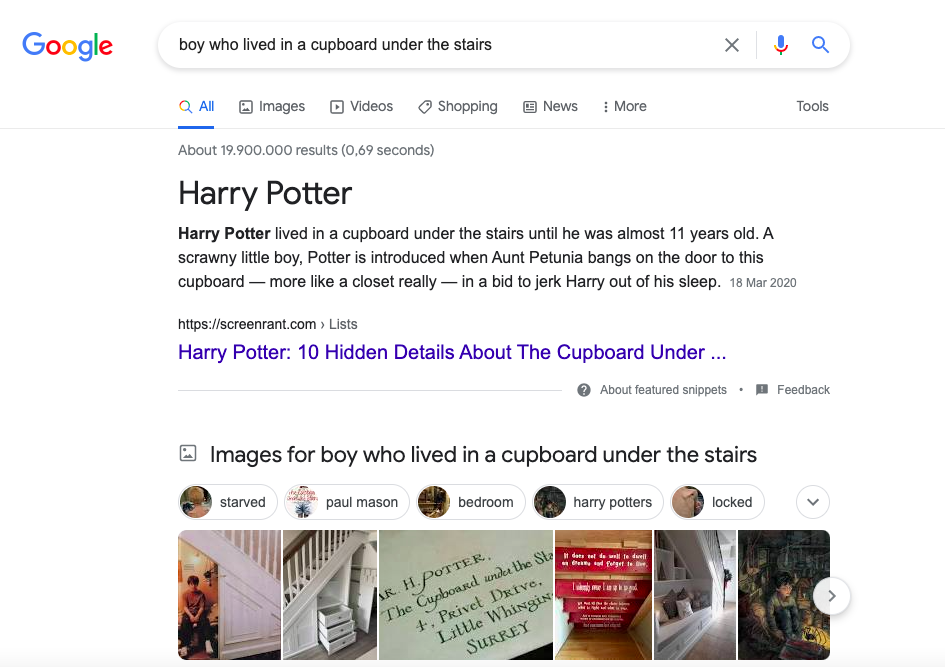
A more impressive example is when you type “boy who lives in a cupboard under the stairs” on Google. Google understands the reference to the Harry Potter saga and suggests sites related to the wizard’s universe.
What are the three types of semantic analysis?
Semantic analysis can be broadly categorized into three main types, each focusing on different aspects of meaning in language:
Lexical Semantics:
- Definition: Lexical semantics is concerned with the meaning of individual words and the relationships between them.
- Key Concepts:
- Word Sense Disambiguation (WSD): Determining the correct meaning of a word in a particular context.
- Synonymy and Antonymy: Understanding words with similar or opposite meanings.
- Polysemy: Handling words that have multiple meanings.
- Lexical Relations: Studying relationships such as hyponymy (e.g., “dog” is a hyponym of “animal”), meronymy (e.g., “wheel” is a part of “car”), and homonymy (e.g., “bat” as an animal and “bat” as a sports equipment).
Compositional Semantics:
- Definition: Compositional semantics focuses on how the meanings of individual words combine to form the meanings of larger linguistic units, such as phrases and sentences.
- Key Concepts:
- Syntax-Semantics Interface: Understanding how syntactic structures influence the interpretation of meaning.
- Semantic Roles: Identifying roles like agent, patient, and instrument within a sentence.
- Truth Conditions: Analyzing sentences to determine the conditions under which they are true or false.
- Scope and Ambiguity: Handling issues related to quantifiers and scope (e.g., “every student read a book” can have different interpretations).
Pragmatics:
- Definition: Pragmatics deals with the meaning of language in context and how it is influenced by factors such as speaker intention, social context, and conversational implicatures.
- Key Concepts:
- Speech Acts: Understanding the functions of utterances, such as requests, promises, and commands.
- Deixis: Handling words and phrases that require contextual information to interpret (e.g., “this,” “that,” “here,” “there”).
- Implicature: Inferring meanings that are not explicitly stated but are implied by the speaker.
- Contextual Interpretation: Considering the broader context in which a conversation or text occurs to understand meaning fully.
Each type of semantic analysis plays a crucial role in comprehensively understanding and interpreting language, enabling more effective communication and interaction with natural language processing systems.
What are the key aspects of semantic analysis?
Here are some key aspects of semantic analysis:
- Word Sense Disambiguation: Determining the correct meaning of a word based on its context. For example, the word “bank” can refer to the side of a river or a financial institution, and semantic analysis helps in identifying the correct sense.
- Named Entity Recognition (NER): Identifying and classifying proper nouns in text into predefined categories such as names of people, organizations, locations, dates, and more.
- Semantic Role Labeling: Assigning roles to different words or phrases in a sentence that describe their relationship to the main verb. For example, in the sentence “John gave Mary a book,” semantic analysis identifies “John” as the giver, “Mary” as the receiver, and “a book” as the object.
- Synonymy and Antonymy: Identifying words that have similar meanings (synonyms) or opposite meanings (antonyms).
- Sentiment Analysis: Determining the sentiment expressed in a piece of text, whether it is positive, negative, or neutral.
- Topic Modeling: Identifying the main topics or themes present in a large collection of texts.
- Coreference Resolution: Determining when different words or phrases refer to the same entity in a text. For instance, recognizing that “he” and “John” refer to the same person in a given context.
- Relationship Extraction: Identifying and categorizing the relationships between entities within a text.
Semantic analysis is crucial for understanding the nuances of human language and enabling machines to interact with and process natural language meaningfully. It is widely used in chatbots, information retrieval, machine translation, and automated summarization applications.
Why Use Semantic Analysis?
Semantic analysis transforms raw textual data into meaningful insights by understanding the context and nuances of language. This capability enhances natural language processing applications, improves search engine results, and enables sophisticated chatbots and sentiment analysis for better decision-making and user experiences.
SEO no longer relies solely on keywords
Traditionally, to increase the traffic of your site thanks to SEO, you used to rely on keywords and on the multiplication of the entry doors to your site.
However, this is no longer sufficient. Because of the implementation by Google of semantic analysis in the searches made by users.
Google’s objective through its semantic analysis algorithm is to offer the best possible result during a search.
For companies, the objective is to have the best position on Google by boosting their natural referencing.
As you can see, to appear in the first positions of a Google search, it is no longer enough to rely on keywords or entry points, but to make sure that the pages of your website are understandable by Google.
What are its advantages?
By integrating semantic analysis in your SEO strategy, you will boost your SEO because semantic analysis will orient your website according to what the internet users you want to target are looking for.
It will help you to use the right keywords to help Google understand the topic, and show you at the top of the search results.
In addition, semantic analysis will allow you to diversify the entry points to your site, by optimizing all the pages of your site as well as using long-tail expressions that allow you to reach an audience that is looking for a specific product or information and that, therefore, will click more on your site.
The semantic analysis will allow you to answer different types of requests. For this, we categorize 4 types of keywords:
- Commercial: with very low traffic, they will direct the Internet user who is looking for an immediate purchase towards the product or service that you sell.
- Informational: with very high traffic, they will inform the user.
- Transactional: their purpose is to prepare a purchase by comparing the different existing offers.
- Navigational: their goal is for the user to find a site already visited.
What is a Semantic Analysis Tool?
A semantic analysis tool is software often based on artificial intelligence. It automatically analyzes a website’s textual data to quickly understand what users of a search engine use as keywords, expressions, etc.
Sentiment analysis tools work by automatically detecting the tone, emotion, and turn of phrases and assigning them a positive, negative, or neutral label so you know what types of phrases to use on your site.
There are many semantic analysis tools, but some are easier to use than others.
SEO Quantum – The Main Reference in Semantic Analysis
SEO Quantum is a natural referencing solution that integrates 3 tools among the semantic crawler, the keyword strategy, and the semantic analysis.
- Semantic analysis: the content of a website is analyzed to make a complete assessment of the pages, content, and their performance in order to optimize it.
- Keyword Strategy: This feature allows you to find relevant keywords used by Internet users. This tool that SEO Quantum offers can also be interesting for the creation of a semantic cocoon that will allow you to better position yourself on Google compared to your competitors.
- Semantic Crawler: this tool allows you to perform a complete semantic audit to identify the pages of a site that are problematic on the semantic aspect and to optimize the others.
Another important point: SEO Quantum includes a tool to generate article topics, which is useful in case of a lack of inspiration.
The semantic analysis report of a topic is also very powerful. It allows analyzing in about 30 seconds a hundred pages on the theme in question.
With this report, the algorithm will be able to judge the performance of the content by giving a score that gives a fairly accurate indication of what to optimize on a website.
In addition, SEO Quantum communicates a very powerful semantic analysis report, sharing with you:
- The type of content scanned,
- The query intent of Google users,
- And the title tags.
Benefits:
- time-saving;
- wide choice of subscriptions;
- accessible and easy interface;
- semantic oriented and specialized.
Disadvantages:
- Used a lot: no specialization and demarcation.
Price:
- 39€ per month: semantic analysis
- 89€ per month: same plus semantic crawler
- 239€ per month: same plus keyword strategy
TextOptimizer – The Semantic Analysis-Oriented Tool
TextOptimizer is a solution that aims to improve the performance of natural referencing of a web page by proposing a list of keywords to be favored as expressions, semantic fields, synonyms …
This tool takes into account the texts entered, returns a percentage score to the proposed content in relation to the query, and will provide a list of keywords to add (or remove) to the content to boost its positioning on search engines.
The Chrome extension of TextOptimizer, which generates semantic fields, is also very useful when writing content, which avoids constantly using the website. Note that it is also possible to load unpublished content in order to assess its effectiveness.
The website can also generate article ideas thanks to the creation help feature. This will suggest content based on a simple keyword and will be optimized to best meet users’ searches.
Advantages :
- chrome plug-in ;
- fast ;
- multilingual (convenient for international companies)
- easy to use ;
- results are customizable (customizable on multiple search engines);
- unlimited search volume.
Disadvantages:
- no keyword data;
- specialized in semantic analysis ;
- sometimes overloaded interface.
Price: Free version available, premium from 60€ per month.
YourText.Guru – An Effective Solution

Like many semantic analysis tools, YourTextGuru provides a list of secondary keywords and phrases or entities to use in your content.
Once the text is written, you can also have your text analyzed. In addition to the top 10 competitors positioned on the subject of your text, YourText.Guru will give you an optimization score and a danger score.
Advantages:
- presence of a risk score
- suggested questions
- full PDF brief
Disadvantages:
- no keyword data provided
In Conclusion
In this article, we have seen what semantic analysis is and what is at stake in SEO. We have also presented 3 semantic analysis tools.
That said, you can consult our Complete Guide to SEO if you want to go further. We can also recommend the best SEO agencies in the United States or your region to help you build your strategy.
Key Takeaways:
Key Takeaways: “Semantic Analysis: Definition, Why Use It, and Best Tools in 2024”
Semantic Analysis Overview: Enables machines to interpret word meanings in context, crucial for SEO, NLP, and AI applications.
SEO Application: Enhances website rankings by aligning content with user intent and improving inbound marketing strategies.
Types and Key Aspects:
- Lexical Semantics: Word meanings and relationships.
- Compositional Semantics: Combining word meanings in phrases/sentences.
- Pragmatics: Contextual language use considering speaker intention.
- Includes word sense disambiguation, named entity recognition, and sentiment analysis.
SEO Benefits: Improves content optimization, search rankings, and visibility by targeting relevant keywords and user intent.
Top Tools:
- SEO Quantum: Comprehensive semantic analysis and keyword strategy.
- TextOptimizer: Keyword suggestions and content creation tools.
- YourText.Guru: Secondary keywords, content scores, and competitor analysis.
Implementation: Understand principles, integrate into SEO, and select the right tools for effective content optimization and improved search rankings.


