


Key Influencer Marketing KPIs: How to Measure Success

Influencer marketing KPIs vary widely depending on who you ask. 68% of brands focus on measuring social media engagement metrics. 50% focus on link traffic from posts. 45% focus on website traffic during campaigns. But the truth is, in order to set KPIs accordingly, you first need to determine the goal of your campaign.
Read on to understand which KPIs you can work with, when to use which, and how to find the metrics for each.
Understanding Influencer Marketing KPIs
Influencer marketing key performance indicators (KPIs) are specific metrics used to evaluate the success and impact of your influencer-driven campaigns.
These KPIs help you, as a brand, determine the effectiveness of your influencer partnerships and measure various aspects such as brand awareness, audience engagement, and return on investment (ROI).
Importance of Measuring KPIs in Influencer Marketing
Influencer marketing KPIs serve as a compass to guide you in achieving your campaign goals.
They are there to help you:
- 📈Understand the effectiveness of your campaigns.
- 📊Identify areas for improvement and optimize your strategy.
- 🔎Gain valuable insight into your target audience and their behavior.
- 🤝Make informed decisions about which influencers to work with.
Setting KPIs for Influencer Marketing Campaigns
But how do you determine which KPIs to work with? The answer lies in your campaign goals.
We recommend that you follow this 4-step process to select the metrics that will give you the most relevant data.
- 🎯Set clear and measurable goals using the SMART method.
- 👥Consider your target audience and their social media habits.
- 📈Select and integrate your KPIs with your specific influencer campaign goals.
- 💓Work with both quantitative (e.g. reach and engagement) and qualitative KPIs (e.g. audience sentiment and feedback).
Read on to understand the different KPI options you can have for each campaign goal.
Influencer Marketing KPIs to Measure
Most influencer campaign objectives fall into one of these options:
- Creating brand awareness
- Increasing website traffic
- Increasing engagement
- Increasing conversions
- Improving brand sentiment
- Improving audience growth
As you can see in the chart below, each is tied to a different set of metrics that you should closely track, monitor, and compare.
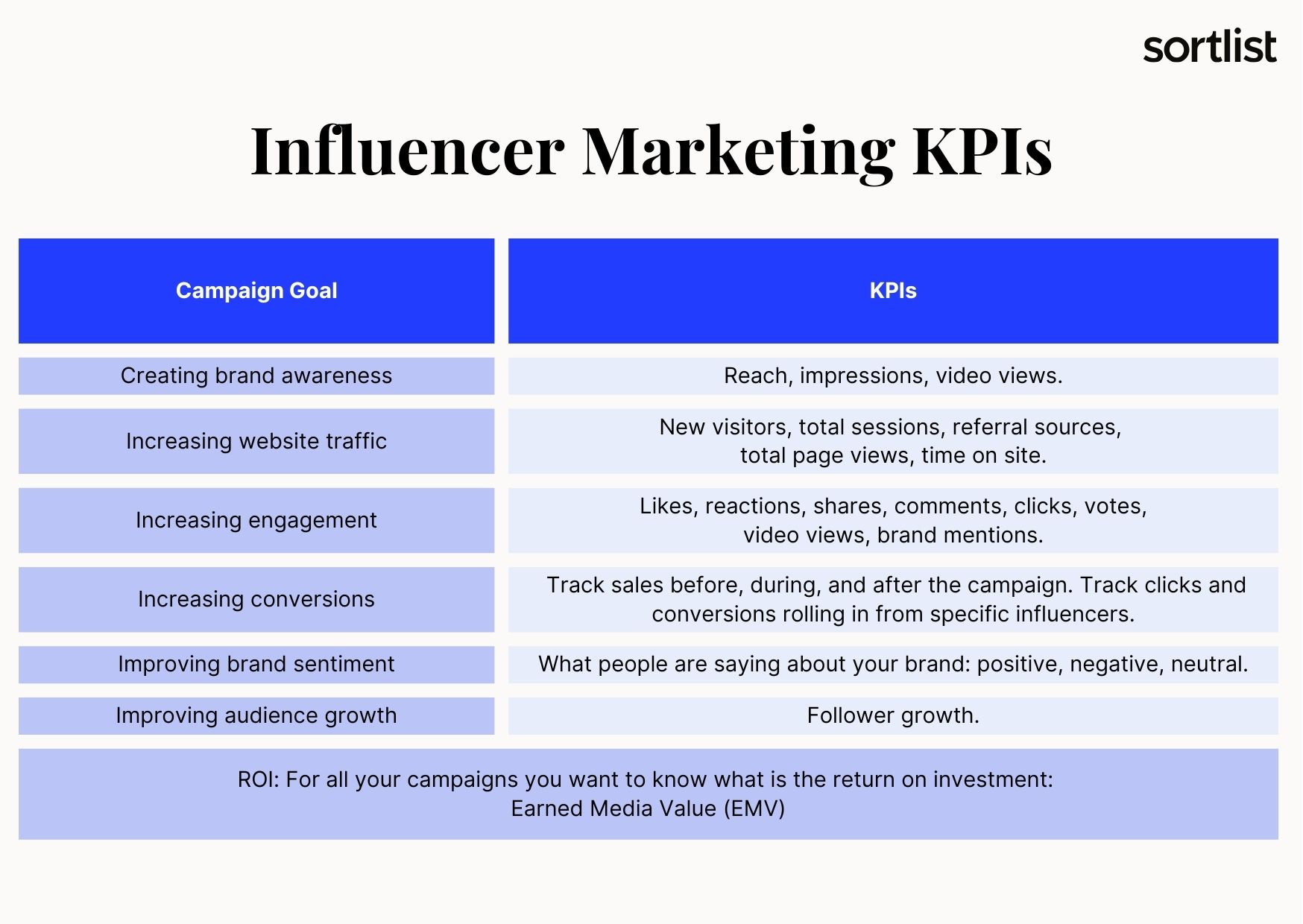
As you can see, there are some KPIs that are very straightforward (e.g., site traffic, total page views, likes, comments, video views, etc.), but click-through rate and earned media value (serves to estimate ROI) are a bit more complex.
Click-Through Rate (CTR)
- The click-through rate (CTR) measures how frequently a prospective customer clicks on a specific link in a sponsored post.
- Calculate CTR using the formula: CTR = clicks / # of impressions x 100.
Earned Media Value (EMV)
- EMV quantifies the value of organic coverage. It is used to estimate the ROI of an influencer marketing campaign.
- Calculating EMV is tricky, but you can use this formula: EMV = (Impressions + Reach) x CPM + (Likes = Comments) x CPE
How to Track Influencer Marketing KPIs
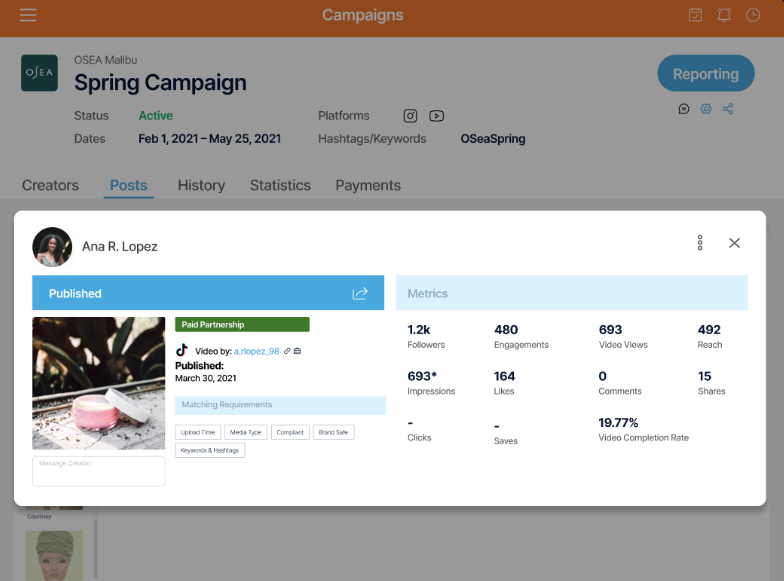
To collect the data for each KPI, you need to work with different tools. Here’s a quick recap of what you’ll need to do and the tools that will come in handy.
Choose the Correct Tracking Tools
Once you have a clear goal and KPIs, you want to select the influencer marketing tools that will help you collect, monitor, and track all the data you need.
Some of the most common options are
They all have their own set of features, but they’re all packed to help you set up your campaigns, find the best influencers to work with, monitor results, and most importantly, measure the impact of the partnerships you’ve built.
⚠️In addition, you’ll want to keep a close eye on your Google Analytics page to see which posts and influencers are driving the most traffic to your site.
Set Up Your Tracking Tool
Once you have decided which platform to use (based on features, cost, and ease of use), you need to start setting it up. They all have different processes, but with the help of their customer support teams (and YouTube videos), you can get started.
🔗If necessary, consider using specific UTM links with each influencer. That way, you can easily understand who is delivering results and who is not.
Most of these platforms will help you track each link and view the results on their dashboards.
Analyze Data
Once you have completed the setup, you are ready to begin collecting data. It’s important that you do this on a consistent basis, not when the influencer campaign comes to an end. You want to be able to understand who’s delivering results and who’s not so you can make any necessary adjustments and get the most out of your investment.
Conclusion
Influencer marketing KPIs help you understand whether or not your efforts are paying off. Partner with an influencer marketing agency and let them handle all the hurdles of finding the right influencer, negotiating, briefing them, and closely monitoring their performance.
Get started today and let others spread the word about your brand, products and services.


