


April Fools’ case study: the formula to a viral campaign

Last update: 31 March 2025 at 04:37 pm
Blenheim Palace didn’t just pull off an April Fools’ joke. They tricked the BBC and wound up with 2.13 billion in total media coverage 🤯

The idea was simple. The 16th-century Blenheim Palace (a stately home and tourist attraction in the English village of Woodstock) had uncovered evidence of the original Woodstock festival in 1769: exactly 200 years before.
And as well as the BBC, Blenheim Palace, together with PR agency Cab Campaign, landed coverage in The Times, The Telegraph, The Mirror, and many, many more.
But behind this seemingly simple prank was a masterclass in PR strategy and April Fools’ fun. And in this edition of Great Business Stories, we’ll dissect the DNA of a perfect April Fools’.
(And if you’re not subscribed yet, you can do so here.)
Let’s dive in 👇
The anatomy of a perfect April Fools’ campaign 🎭
The Blenheim campaign was simple. In fact, here’s the press release:

But in chatting with Jon from Cab Campaign, he revealed a few of the key aspects of the campaign… that you might not expect:
Make it newsworthy, no matter what
Journalists probably won’t believe you. And that’s OK.
April Fools’ isn’t about tricking journalists. It’s about creating something so clever they want to cover it anyway.
You can get as much value from the round-ups of creative campaigns and social media buzz from followers in on the joke.
If it is believed by a major outlet… that’s rocket fuel for reach. But you can’t rely on that.
So aim for fun and aim for creativity to make it newsworthy in its own right.
Keep it simple & believable (the one-liner test)
A good rule is – can you sum it up in one line? If it’s possible, you’re on the right track.
One of the reasons Blenheim’s campaign was so successful is that its essence can be captured in one image:

Add authority to make it stick
A key element that made the prank believable was the Blenheim Palace Archivist.
Dr. Alexa Frost is the guardian of the centuries-old palace archive. Her academic weight is what turned the story from a quirky coincidence into a potential historical find.
You could do the same with:
🃏 A fake but “official” research study.
🃏 An industry figure endorsing your hoax.
🃏 A fictional government mandate.
Hide easter eggs for maximum engagement
Vincent Furnier (Alice Cooper to you and me) playing at the “original Woodstock” was a dead giveaway, for some.
This easter egg was a little wink to those paying close attention. But it also played perfectly into the media cycle:

- For those who missed it, the revelation that they’d been fooled only added to the fun.
- For those in the know, it gave bragging rights: a reason to share the story and highlight the cleverness.
Letting people feel smart makes them want to share it, and it gives journalists an extra angle.

A well-crafted April Fools’ campaign can generate millions in organic reach, but only if you get the strategy and execution just right.
Working with the right PR agency can be the difference between a simple prank and a headline-grabbing win.
Browse through vetted PR providers that will give your brand the boost it needs.

The three April Fools’ playbooks 🃏
Cab Campaign’s Blenheim Palace prank was squarely focused on generating maximum buzz for the attraction. But that’s only one of three distinct ways to think of your campaign, depending on your objective.
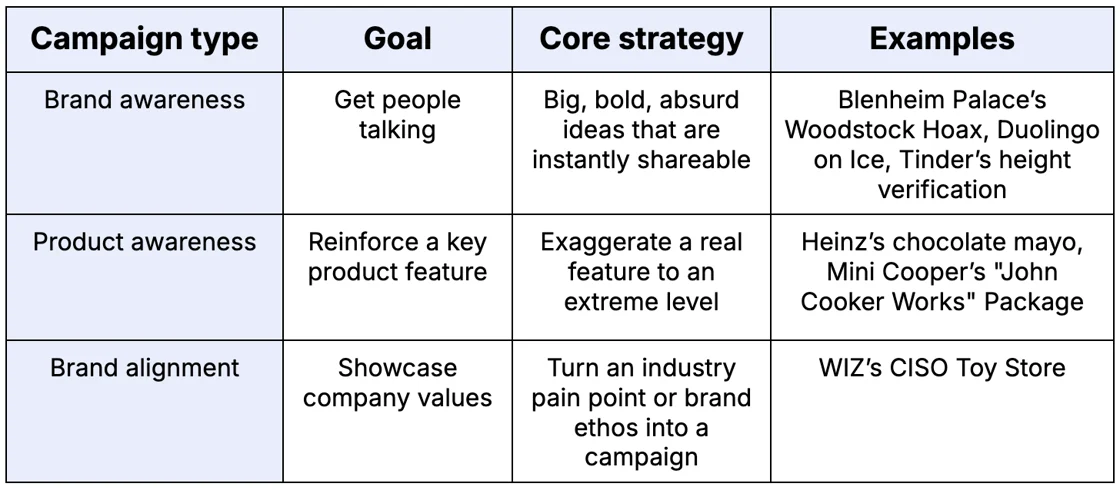
Achieve brand awareness
The Blenheim palace campaign is a perfect example of an April Fools’ campaign focused on generating maximum exposure with minimum effort.
As with all April Fools’ campaigns, it should contain a grain of truth (Blenheim really hosts concerts). But the link doesn’t have to be specific.
🚫 It doesn’t need to tie directly to a product feature.
🚫 It doesn’t need to reinforce brand values.
✅ It’s primarily about getting people to talk: pure viral marketing.
Another example: Duolingo on Ice. Duolingo has a chaotic marketing personality, so a multilingual ice show didn’t seem too crazy. But this would be their wildest campaign yet, generating serious debate online.

Advertise your product or service
1️⃣ Find your product’s best-known feature.
2️⃣ Turn it up to 11.
3️⃣ Make it feel (almost) real.
Heinz – to emphasise their range beyond ketchup and beans – regularly launches campaigns that take product and flavour innovations to the extreme:


And Jon’s favourite: one of Mini Cooper’s key differentiators is that they allow a huge level of customization. That concept was turned up to 11 in 2017 with the launch of the “John Cooker Works Package”:

Align your brand identity
1️⃣ Find a shared pain point in your industry.
2️⃣ Turn it into something extreme but relatable.
3️⃣ Use humour to make it a natural April Fools’.
My favourite proves you don’t need to be a global B2C brand to launch an April Fools’ campaign:
Cloud cybersecurity platform WIZ launched an online toy store for Chief Cybersecuity Officers (Cisotopia) filled with hilarious products only they would find funny.
Why? Because cybersecurity professionals are constantly stressed, and constantly firefighting.

The April Fools’ campaign checklist ✔️
Putting it all together: to make your April Fools’ campaign impactful, shareable, and strategic, here’s a checklist of what we learned from Cab’s Blenheim campaign, and all the others we loved:
Define your goal
First, define what success looks like.
🐝 Want buzz? → Aim for a newsworthy, viral stunt .
📦 Want to reinforce a product characteristic? → Exaggerate a real feature.
📌 Want to strengthen your positioning? → Exaggerate values and mission.
Find your “believable absurdity”
Your idea should live in the sweet spot between plausible and ridiculous.
Can you sum it up in one sentence? If not, simplify it.
Would your audience pause before realizing it’s fake? If it’s too ridiculous, it won’t land.
✅ Blenheim Palace’s Woodstock hoax → Blenheim is in Woodstock.
❌ “Blenheim Palace is moving to London” → Too unbelievable to get traction.
Run the “brand fit” test & set guardrails
April Fools’ is strategic deception. Be careful.
🗣️ Does it align with your brand voice and values?
🤣 Would your customers find it funny or clever?
➕ Would people still think positively about your brand if they do fall for it?
😡 Avoid anything that might cause harm or offense.
It seems obvious, but Blenheim shouldn’t say they’re opening an hour earlier. It’s misleading, not funny. If you’re in a regulated industry (finance, healthcare, legal), be extra careful.
Make it visually compelling (with AI)
A no-brainer in 2025. The best April Fools’ jokes use strong imagery to sell the joke. With AI, that’s easy for businesses of any size.
- Can you create a mock-up image, video, or animation?
- Can the joke be told in a single picture or GIF?
Plan the rollout & outreach
- Embargo your press release until April 1st to maximize coverage.
- Tease it on social media: hint at something big dropping.
- Have a follow-up plan: how will you “reveal” the joke?
Measure the impact
How do you know if your campaign worked?
🐝 Buzz campaigns: measure social media engagement, press mentions, and website traffic spikes.
📦 Product characteristic campaigns: track searches, leads, and potential sales impact.
📌 Brand alignment campaigns: look at brand sentiment, customer feedback, and long-term impact.
Now’s your turn
Blenheim Palace’s success (and others like Heinz’s, Mini’s, and Duolingo’s) shows that an April Fools’ campaign can capture attention beyond April 1st. With minimal effort and maximum impact.
A great April Fools’ story (like all PR campaigns) is about strategy, execution, and distribution. The right PR agency will help you nail the balance, first time.


