

The Agency Search Report: the wrong match is costing the economy $300 billion in 2024
Published on: 12 Nov 2024 | Author: Jorge Uceda

Published on: 12 Nov 2024 | Author: Jorge Uceda
300 billion dollars. That’s what searching and working with the wrong service provider in 2024 is costing companies worldwide. With agencies popping up everywhere, AI changing the game, and fierce competition from brands in your industry, it’s scary to think that your providers are not ensuring your business gets ahead nor taking steps to minimize risks.
Our CMO, Nicolas Finet, said it before: “In the last few years, the number of agencies have exploded, as well as the number of disciplines (SEO, social media, activation, conversation, content marketing). It’s a very confusing landscape for brands, and knowing exactly who to work with becomes, all of a sudden, an unmet challenge.”
This means that having the right partner quickly becomes your competitive asset when it comes to getting ahead of the game, and hence why searching for the right one is a defining move for your business.
But it’s a time-consuming process and, if done wrong, can lead to wasted opportunities. Those aren’t just words—read on to know exactly how much you may be losing by not finding the right provider.
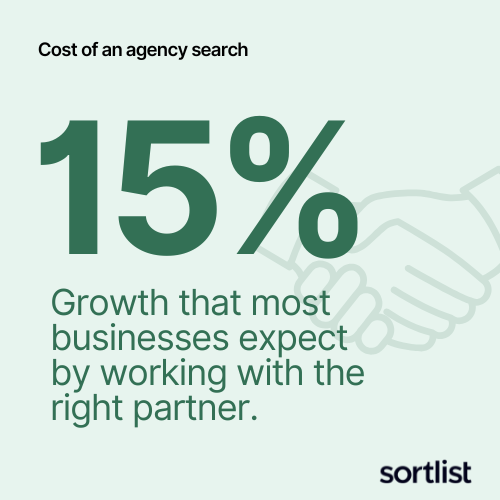
The right providers are a strategic asset to economies and companies worldwide. In fact, businesses expect a 15% growth thanks to working with the right partner.
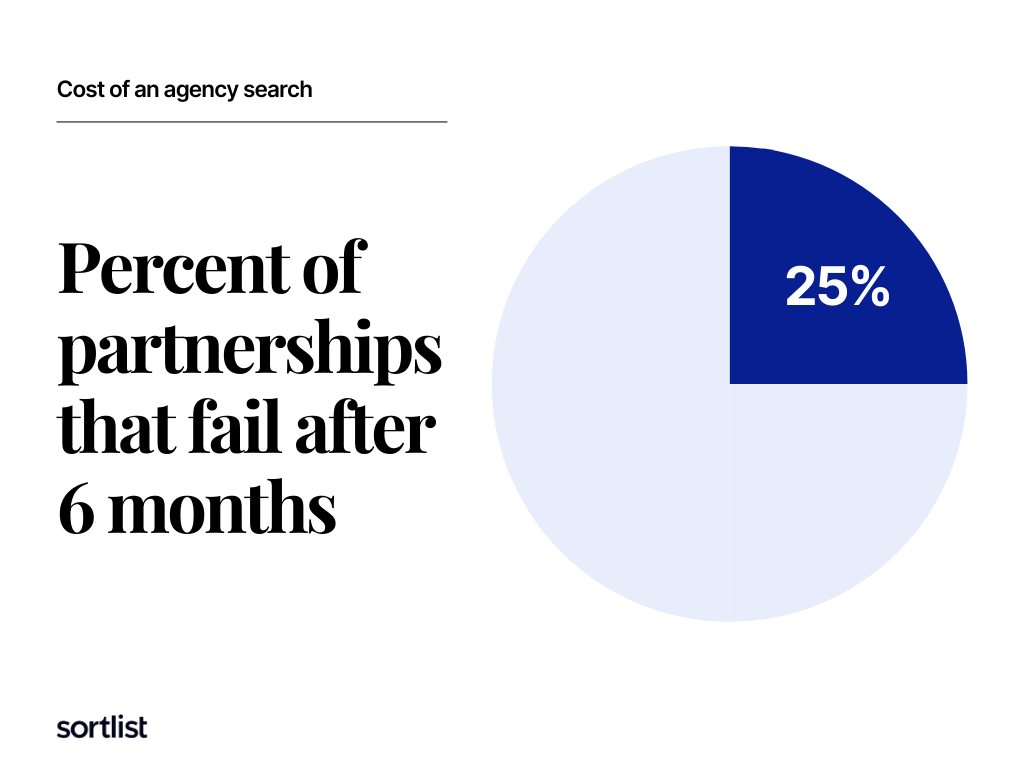
But, on average, 25% of collaborations fail within the first 6 months.
What does this lost opportunity mean for the global economy?
Broken down by country, we took public data regarding economic performance and GDP for several markets and calculated the opportunity costs of businesses that search for an agency yearly.
Specifically, we calculated the expected growth from working with the right partner and the missed growth happening during those wasted 6 months for those who didn’t find the right partner.
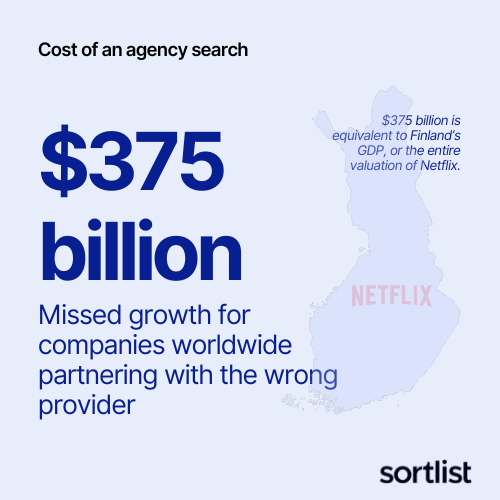
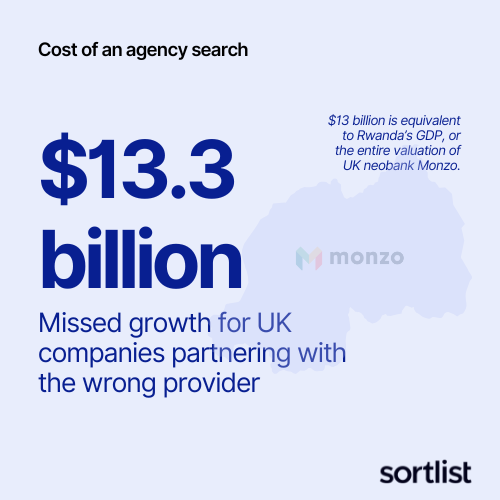
You can see it yourself—the stakes are huge. So we dug into the search process through external research, internal data, and company surveys to understand it better. That is, where are companies searching, who inside them is actually doing the search, how much time is devoted to each step of the process, and how could they regain some of those sunk costs and time spent.
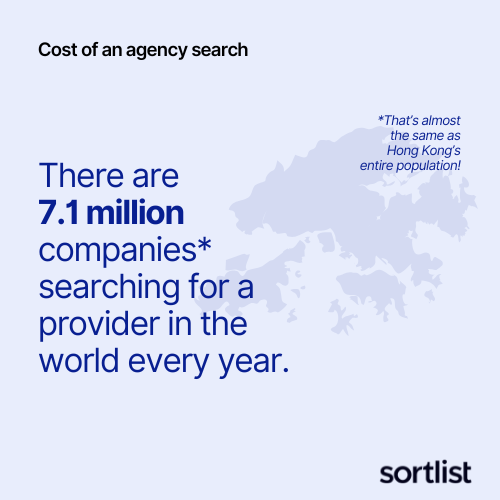
Every year, around the world there are 7,152,345 companies searching for a provider to help their business grow.
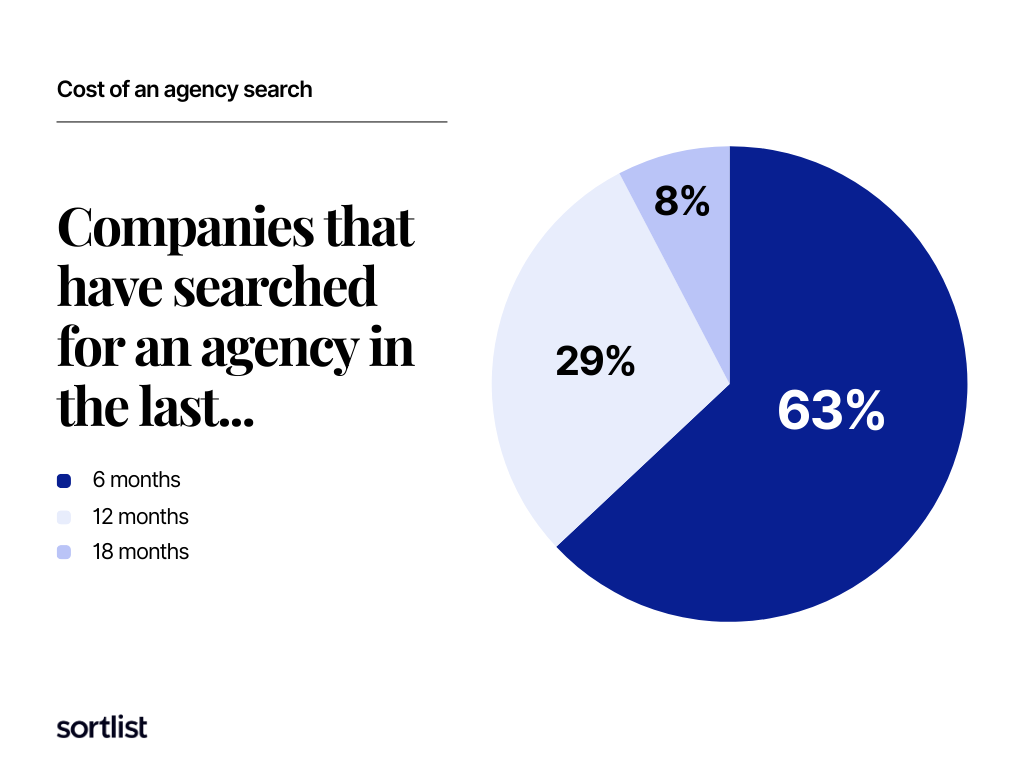
Of those companies that do work with providers frequently, 63% have searched for a provider in the last 6 months.
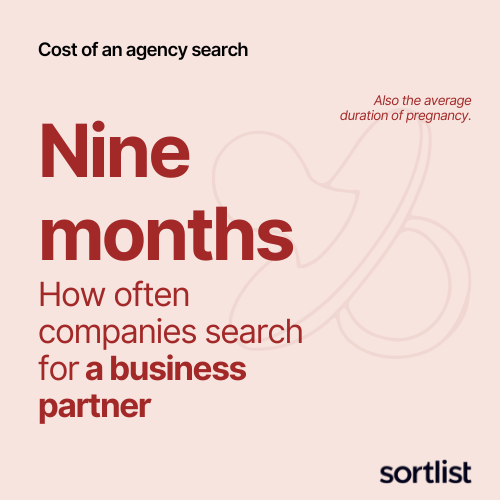
On average, companies who regularly work with external providers search for a new one every 9 months.
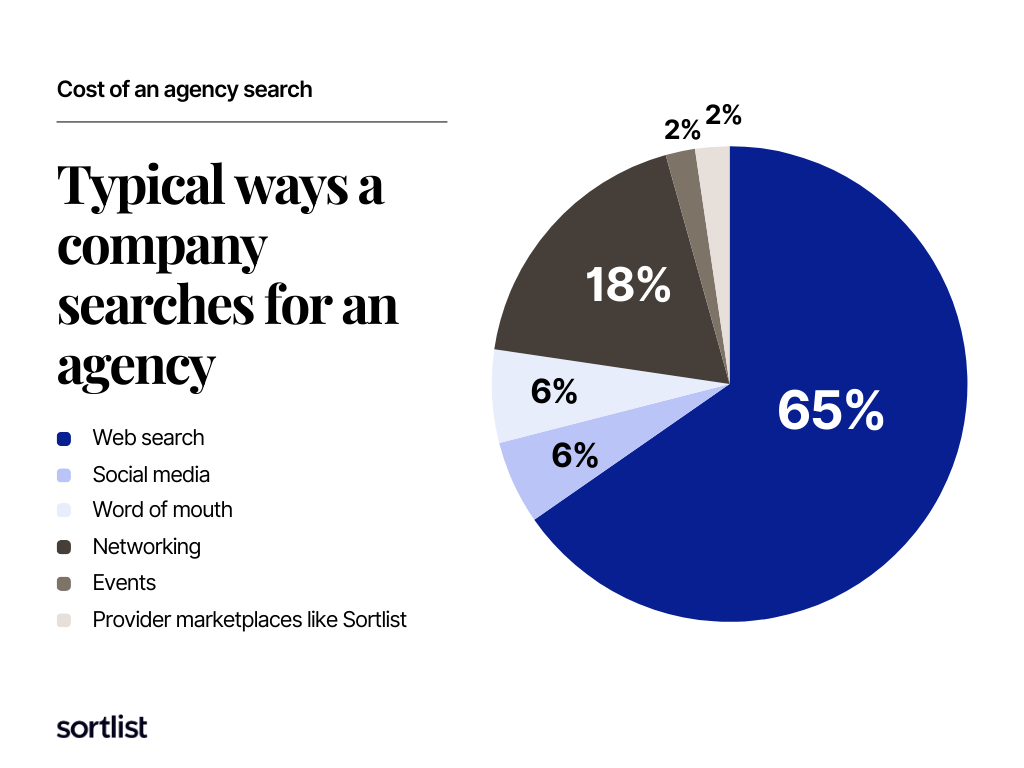
Out of those searching, 65% have used Google. And 18% say they search for providers through networking events.
Only 6% search through social media and word-of-mouth.
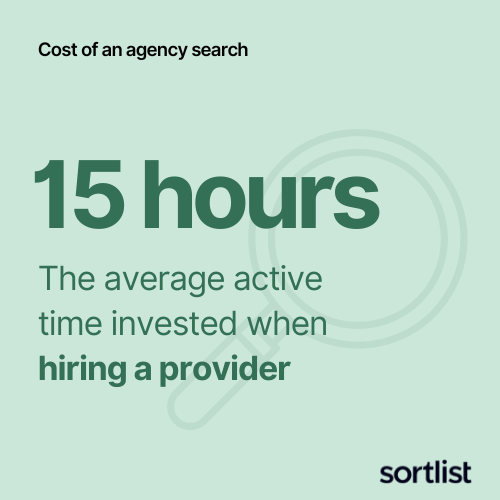
When it comes to the time spent searching, overall, each person spends around 15 hours of active time on the process.
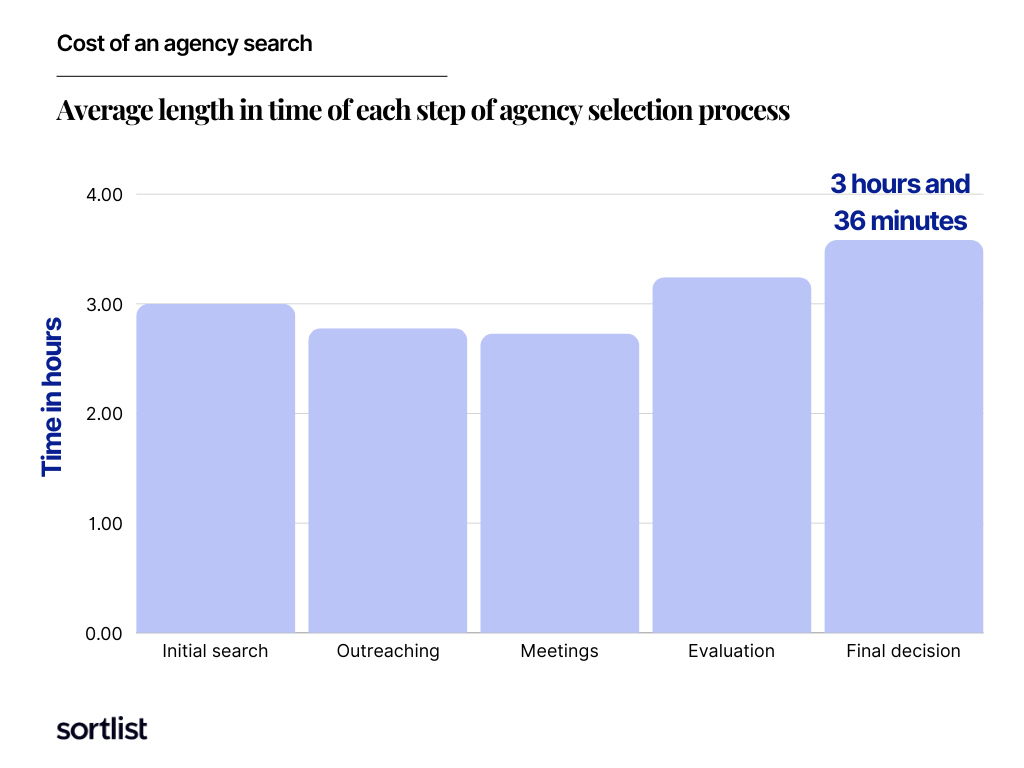
On average it’s the final decision-making stage that takes the longest, about 3 hours and 36 minutes of active time.
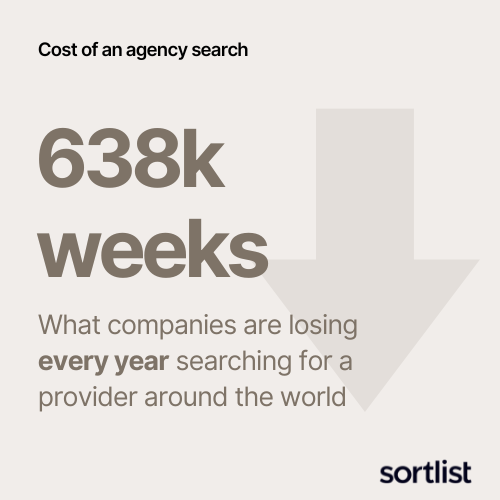
In the context of the 7,152,345 companies searching for a provider, 15 total search hours amount to a total of 107,285,175 hours of search in a year. This means that, all around the world, companies are losing 638,600 working weeks every year searching for a provider.
Looking at time spent and success rate, there is little correlation between time spent on the search and the future success of the partnership.
Those whose success rate is over 90% in fact spend 32% less time searching for their provider than those who have a success rate of 50% or less. That indicates it’s experience, knowledge, and network that has the greatest influence on success, not time spent.
EN time-spent-success-rate by SortlistIn other words, those who have a 90% success rate spend relatively their time on:
Overall, there is an average decrease of 31.55% in the time spent across all steps.
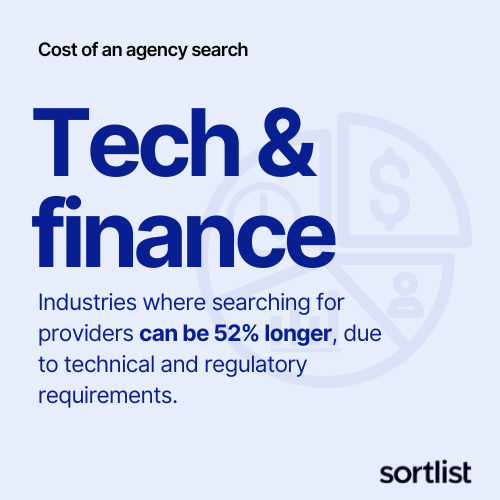
For companies in the tech and financial industries, the process takes 18% longer, but it is notable that the initial search itself takes 52% longer overall (4.7 hours of active searching time), due to more stringent technical and regulatory requirements.
Of those searching for a provider every year, almost half belong in the Operations department of companies. And barely 1 in 5 are C-level executives (CEOs, CMOs, finance directors, etc.).
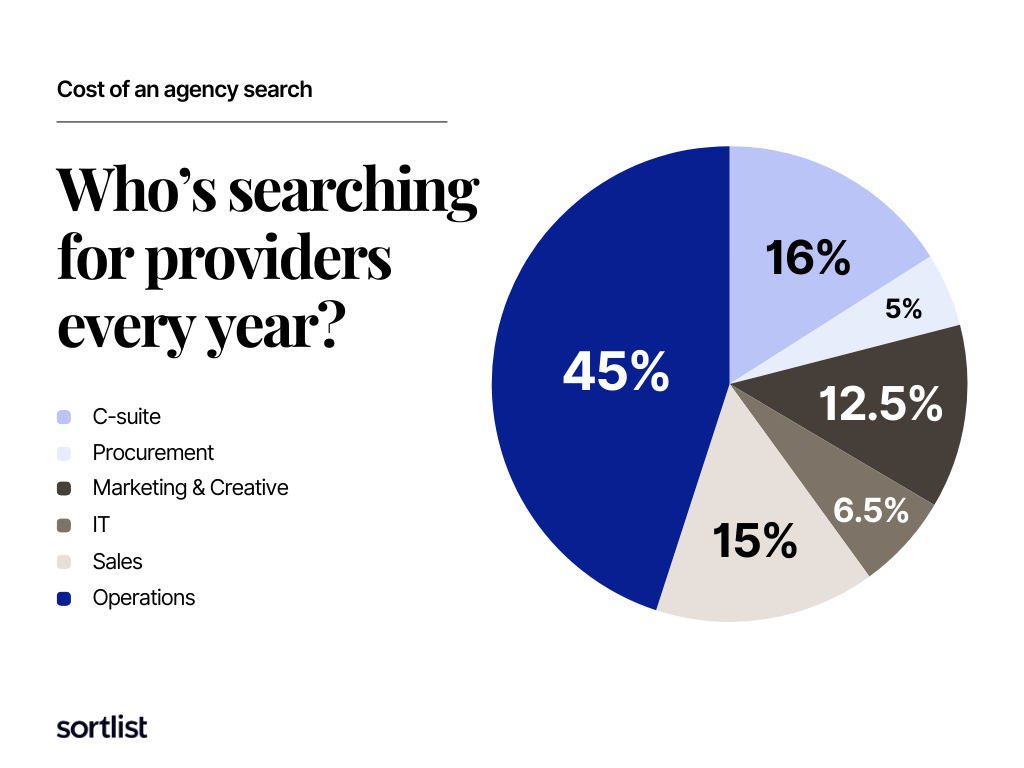
As you’ve seen, the cost of the search is directly related to those doing it. So if we focus on the company costs for each person doing the searching, we can have a clearer picture on the amount of salary spent for each search done wrong.
| Job title | Wage cost (wages spent on a 15-hour search, in USD$) |
| CEO | 1,376.23 |
| CMO | 1,370.66 |
| Communications Manager | 764.01 |
| CFO | 1,443 |
| IT Director | 1,259.61 |
| Procurement Manager | 881.01 |
| Project Manager | 838.96 |
| Marketing Manager | 728.91 |
| Business Development Manager | 795.99 |
| Brand Manager | 830.7 |
| Sales Director | 974.71 |
| Creative Director | 1,083.81 |
| Operations Manager | 702.99 |
| Account Manager | 670.44 |
Taking an average of all the employees we found that it’s costing companies approximately $61 per hour to search for an agency. In 15 hours that’s $915.
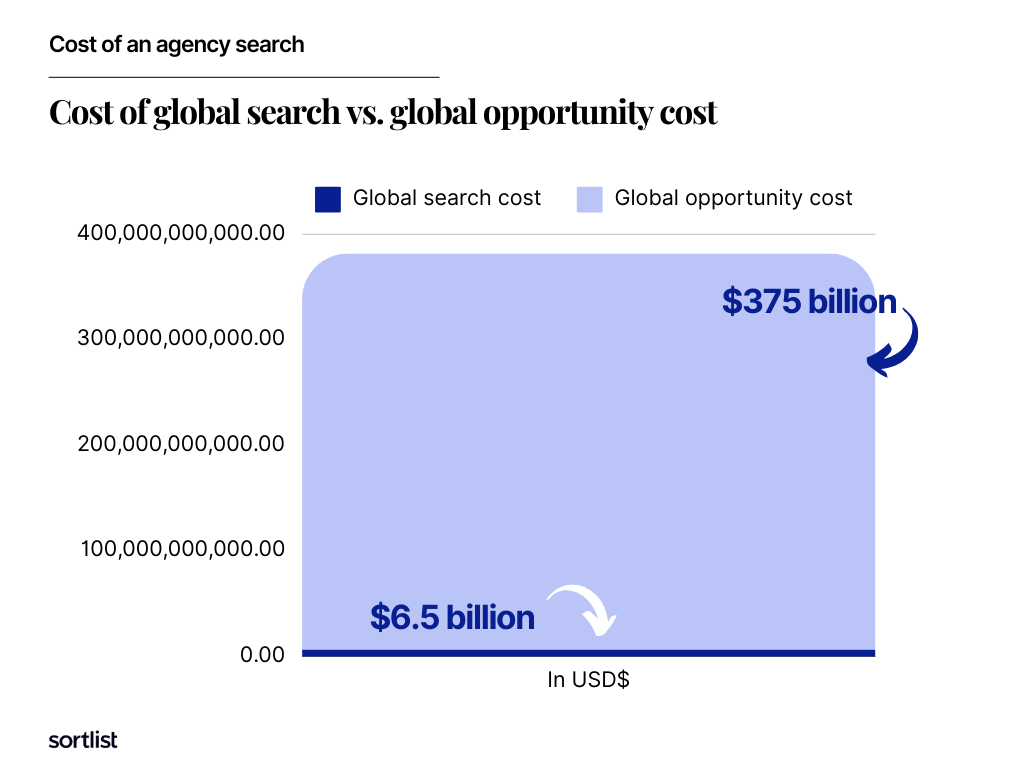
For the 7.1 million companies searching globally for a provider, those $915 add up to $6.5 billion (exactly $6,544,395,675) for every unproductive search and collaboration.
So, if we look at the complete picture:
$6.5 billion in salary cost during search + $375 billion in opportunity cost for growth
= $382 billion (exactly $381,795,850,781) for companies that aren’t searching well.
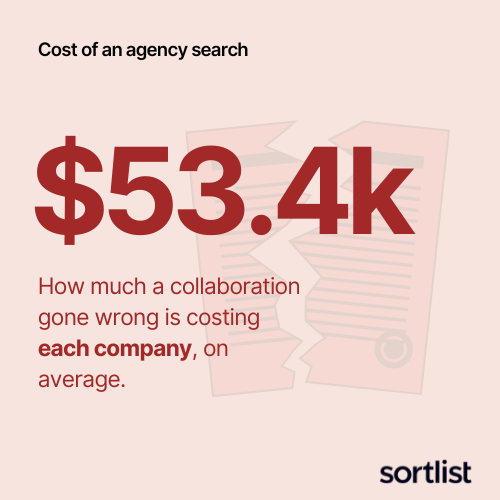
If, then, we divide that by the 7.1 million companies doing the searches, we’ll see that it’s costing each company around $53,381.
That’s significant, especially when considering that the annual salary of positions like digital marketer and data analyst is around $37k and 45k, respectively, in the United Kingdom.
When you’re searching for a service provider, it’s tempting to prioritize speed above all else. After all, the quicker you can select a provider, the sooner you can proceed with your projects. But while accelerating the search process is undoubtedly important, it’s crucial to recognize that speed should not come at the expense of quality. The real financial impact isn’t just in the time spent searching; it’s in the opportunities missed by not partnering with the right provider.
Choosing the right agency is more than a checkbox on your to-do list—it’s a strategic decision that can significantly influence your company’s trajectory. An ill-suited partnership can lead to project delays, subpar results, and even damage your brand’s reputation. These setbacks don’t just cost you time; they cost you valuable opportunities for growth, revenue, and competitive advantage.
In other words, the ultimate goal is to make your time count by securing a partnership that propels your business forward. Because in business, lost opportunities often carry a higher price tag than the time invested to capture them.
The stakes have never been higher when it comes to selecting the right service provider. The sheer volume of agencies and the complexity from new technologies, such as AI, make the whole process not just daunting but also full of financial implications.
You can’t overlook the substantial opportunity costs that occur here—the revenue and growth potential missed while spending excessive time searching for a provider. And the risks of partnering with the wrong agency can lead to failed projects, wasted resources, and a big setback in achieving your business objectives.
Every hour spent on an inefficient search is an hour not invested in strategic initiatives that drive growth, and every misaligned partnership is a hurdle to success.
This is where Sortlist comes into play. With Sortlist you simplify the agency selection process by connecting with a curated list of top-performing service providers tailored to your specific needs. With our combination of expert insight and an advanced matching algorithm, we can ensure you make the right choice the first time.
You can search for your next provider yourself, or you can use Sortlist to turn the task of finding the right service provider into a strategic advantage.
This report is the result of a surveys carried out between October 8th and October 22nd, 2024, to 500 companies about their agency and provider search habits and time frames. Its responses are anonymous.
This report also uses internal data leveraged from Sortlist regarding the number of projects that arrive on its platform, as well as external search data from Google and Ahrefs and public data from the World Bank, the Indeed Salary Guide, and public data from the United Kingdom government website the National Institute for Statistics and Economic Studies in both France and Spain, and data from the North American Industry Classification System.
The Sortlist Data Hub is the place to be for journalists and industry leaders who seek data-driven reports from the marketing world, gathered from our surveys, partner collaborations, and internal data of more than 50,000 industries.
It is designed to be a space where the numbers on marketing are turned into easy-to-read reports and studies.